Jerusalem and Palestine Studies
Jerusalem in Islamic Belief
# Jerusalem in Islamic Belief
The city of Jerusalem, which serves as the meeting point of the three Abrahamic religions founded upon divine revelation, holds a unique significance for each of these faiths. The fact that the paths of the prophets, who were the leaders of monotheistic belief, intersected in this city and that they spent at least part of their lives there has further enhanced its sanctity and value in the eyes of humanity. In this final article of the series, the meaning and significance of Jerusalem for Muslims will be examined in detail, thereby completing this series of articles devoted to the importance of Jerusalem in the three Abrahamic religions.
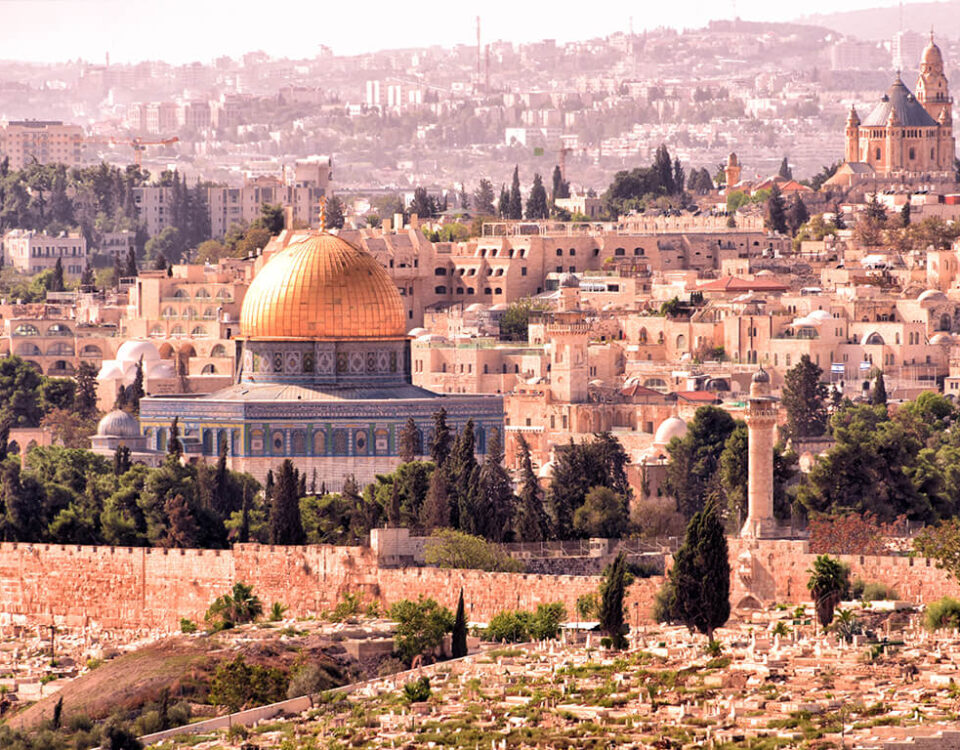
Names such as **al-Quds** (“The Holy”) and **Bayt al-Maqdis** or **Bayt al-Muqaddas** (“The Holy House”), which refer respectively to the city and the sanctuary located there, are among the most common names used in Islamic sources for Jerusalem. The walled sacred precinct that contains **al-Masjid al-Aqsa**, believed to have been built on the site of Solomon’s Temple, and the **Dome of the Rock**, constructed over the rock upon which the Prophet Muhammad (peace be upon him) is believed to have stepped during the Night Journey and Ascension, is known as **al-Haram al-Sharif** (the Noble Sanctuary).
Jerusalem occupies a special position in Islam and is regarded as a sacred city. The primary reasons for this distinction are that it was the first qibla (direction of prayer) of the Muslims and that it witnessed the Prophet’s (peace be upon him) miracles of al-Isra and al-Mi‘raj. Muslims performed their prayers facing Jerusalem until the sixteenth month after the Hijrah. Jerusalem, which is alluded to in numerous Qur’anic verses, was praised by the Prophet Muhammad (peace be upon him), who described it as “one of the three blessed places to which a journey may be undertaken.”
The blessed status of this region is attributed to the divine wisdom of God, who caused many prophets to live, preach, die, and be buried there, as well as to the natural abundance of its fruits and crops. Throughout Islamic history, Jerusalem served as a major center of learning and spirituality. Prominent scholars such as **‘Abd al-Rahman al-Awza‘i**, **Sufyan al-Thawri**, **Layth ibn Sa‘d**, and **Muhammad ibn Idris al-Shafi‘i** taught and trained students in Jerusalem. Likewise, scholars such as **Imam al-Ghazali**, **Ibn Qaysarani**, and **Abu Bakr Ibn al-‘Arabi** resided and lectured there. Renowned Sufi masters including **Rabi‘a al-‘Adawiyya**, **Bishr al-Hafi**, and **Sari al-Saqati** lived in the city and contributed greatly to its spiritual flourishing.
## JERUSALEM IN THE QUR’AN AND HADITH
Jerusalem is not mentioned by name in the Qur’an. However, it is referred to indirectly in more than ten verses. In addition, Jerusalem is the subject of numerous sayings (hadiths) of the Prophet Muhammad (peace be upon him). Both the Qur’anic references and the hadith literature indicate that Jerusalem’s sanctity is closely connected to the sacred sanctuary located within it.
Among the verses most directly associated with Jerusalem is the opening verse of Surat al-Isra:
> “Glory be to Him who took His servant by night from al-Masjid al-Haram to al-Masjid al-Aqsa, whose surroundings We have blessed, in order to show him some of Our signs. Indeed, He is the All-Hearing, the All-Seeing.” (Qur’an 17:1)
Classical Qur’anic commentators have interpreted this verse as evidence for the Prophet’s Night Journey (Isra) and Ascension (Mi‘raj).
Among other verses associated with Jerusalem is the statement concerning the Prophet Zechariah:
> “Then he came out to his people from the sanctuary and signaled to them to glorify God morning and evening.” (Qur’an 19:11)
Another example is the verse:
> “And when the second promise came to pass, We sent your enemies against you to disgrace you and to enter the Mosque as they had entered it before, and to destroy completely whatever they conquered.” (Qur’an 17:7)
Numerous hadiths describe the virtues and importance of al-Masjid al-Aqsa. Its significance is especially connected to the events of al-Isra and al-Mi‘raj. Qur’anic commentators have consistently maintained that the sanctuary visited by the Prophet during the Night Journey was Bayt al-Maqdis.
Indeed, in the famous narration of the Isra, the Prophet said:
> “I mounted al-Buraq and arrived at Bayt al-Maqdis in Jerusalem…”
The hadiths indicate that the Prophet led the assembly of prophets in prayer there before ascending to the highest heavens.
The Prophet also taught that the first mosque established on earth was the Kaaba and that the second was al-Masjid al-Aqsa. He further stated that journeys undertaken specifically for worship should be directed only to three mosques: the Sacred Mosque in Mecca, the Prophet’s Mosque in Medina, and al-Masjid al-Aqsa.
In another hadith, he explained that the greatest reward for prayer is attained in the Kaaba, followed by prayer in the Prophet’s Mosque and then prayer in al-Masjid al-Aqsa. He encouraged Muslims to visit al-Masjid al-Aqsa and perform prayers there, and advised those unable to travel to contribute olive oil for the lamps of the sanctuary.
## THE MUSLIM CONQUEST OF JERUSALEM
Jerusalem came under Muslim rule during the caliphate of Umar ibn al-Khattab. At that time, the region of Palestine was under Byzantine control. Following the Battle of Ajnadayn (13 AH / 634 CE), the first major engagement between the Muslims and Byzantines, the gates of Syria and Palestine were opened to the Muslims. With the decisive Muslim victory at the Battle of Yarmuk (15 AH / 636 CE), Syria was taken from Byzantine control, and the conquest of Palestine began.
Jerusalem was besieged by Abu Ubaydah ibn al-Jarrah, but the city's formidable walls prevented its immediate capture. The Muslim soldiers were fully aware that the city they had surrounded was no ordinary place. Abu Ubaydah maintained the siege until the inhabitants of Jerusalem became exhausted. Unable to withstand the hardships of the prolonged blockade and recognizing that they had no alternative but surrender, the Christian residents sought safe conduct from the Muslims and proposed an agreement. However, they stipulated that the city would be surrendered only to the Caliph himself.
Abu Ubaydah informed Caliph Umar of the situation and invited him to Jerusalem. Umar gathered the leading Companions of the Prophet and consulted them regarding the matter. During these discussions, both Ali ibn Abi Talib and Umar himself argued that it would be beneficial for the Caliph to travel personally to Jerusalem.
Eventually, Umar departed from Medina and journeyed to Jerusalem, where he formally received the city's surrender from Patriarch Sophronius and signed the treaty. Thus, Jerusalem entered Muslim rule without bloodshed. The inhabitants were granted guarantees for the safety of their lives, property, churches, and institutions.
This document, which became famous in Islamic history as the **Covenant of Umar**, later served as a model for Muslim conduct toward non-Muslim populations in conquered territories. Indeed, when Sultan Mehmed II conquered Constantinople centuries later, he issued similar guarantees to the city's Christian and Jewish inhabitants.
Although historical sources differ regarding the exact date of the conquest, placing it in either 16, 17, or 18 AH, the strongest opinion suggests that it occurred at the end of 17 AH or the beginning of 18 AH. Umar's entry into Jerusalem corresponds to the year 638 CE.
The Roman name of the city, **Aelia Capitolina**, was replaced by the name **Jerusalem (al-Quds)**, and **Ubadah ibn al-Samit** was appointed as judge and governor in order to teach Islam to the population.
### Accounts of Umar's Justice
Historical sources preserve numerous anecdotes concerning Umar's justice and humility during the conquest of Jerusalem.
According to one report, Umar and his servant alternated riding a single mount. As they approached Jerusalem, it happened to be the servant's turn to ride. Although the servant insisted that Umar should ride instead, Umar refused, thereby teaching a lesson in humility to those who had come out to welcome him.
Another famous account relates that while Umar was meeting with Christian leaders inside the Church of the Holy Sepulchre, the time for the noon prayer arrived. Umar asked the Patriarch to designate a place where he could pray. The Patriarch offered the church itself, but Umar declined. Instead, he moved a short distance away, spread his cloak upon the ground, and led the Muslim soldiers in prayer.
A mosque was later constructed on the site where Umar prayed, and it still exists today. Umar explained his decision by saying:
> "If I pray here, future Muslims may claim: 'Umar prayed here,' and they will convert this church into a mosque."
Through this action, he demonstrated respect for the religious beliefs and sacred places of Christians.
Another celebrated narrative concerns Umar's discovery of the location of Solomon's Temple. Sources preserve two versions of this story.
According to one account, Umar asked Patriarch Sophronius to show him the location of the Temple. Upon arriving, he found the site covered with refuse and used as a dumping ground. Umar spread his cloak, began gathering the rubbish, and personally carried it away. Inspired by his example, the Muslims joined him, and after the area was cleaned, a mosque was built there. The present site of al-Aqsa Mosque is traditionally associated with Umar's mosque.
Another version states that the exact location of the Temple had been forgotten. During his investigations, Umar concluded that a place being used by local women as a rubbish dump marked the Temple's location. He reportedly scattered a purse of gold coins over the site, causing local idlers to flock there in search of treasure. Their digging eventually revealed the remains of the Temple. Interestingly, a similar story is also attributed to Sultan Suleiman the Magnificent.
Other traditions relate that the Patriarch of Jerusalem first brought Umar to the Church of the Holy Sepulchre, hoping that Muslims would adopt it as their principal sacred site. Umar, however, declared that this was not the place from which the Prophet Muhammad ascended during the Mi'raj. He eventually identified the location now occupied by al-Masjid al-Aqsa.
Following the conquest, Muslims devoted considerable effort to the development and beautification of the city. Without sparing expense, they constructed numerous buildings of great artistic and architectural value. The special care shown toward Jerusalem by Muslims can also be seen in the fact that Caliph Uthman endowed the revenues of the Silwan Gardens for the benefit of the city's poor.
## JERUSALEM THROUGHOUT ISLAMIC HISTORY
With the exception of roughly a century of Crusader occupation, Jerusalem remained under Muslim rule for approximately twelve hundred years after its conquest by Umar.
Whether attacked by Muslim or non-Muslim armies, Jerusalem repeatedly became the target of military campaigns and changed hands numerous times throughout its history. Historical records indicate that during the Middle Ages, Jerusalem was attacked fifty-two times, besieged twenty-three times, and captured and recaptured forty-four times.
### The Umayyad Period (661–750)
Jerusalem remained under Umayyad rule between 661 and 750 CE. When Caliph Mu'awiyah transferred the capital of the Caliphate from Medina to Damascus, Jerusalem gained increased prominence.
The Umayyads left a lasting architectural legacy. The two most important structures visible today within the Haram al-Sharif—the **Dome of the Rock** and **al-Masjid al-Aqsa**—were constructed during this period.
Some sources attribute these buildings to Caliph Abd al-Malik ibn Marwan (d. 705 CE), while others credit his son al-Walid I (d. 715 CE). Al-Masjid al-Aqsa underwent numerous restorations and renovations throughout its history before reaching its present form.
### The Abbasid Period (750–878)
The Abbasids controlled Jerusalem from 750 to 878 CE. The importance of the city to the Abbasids is illustrated by the fact that Caliph Abu Ja'far al-Mansur visited Jerusalem on two separate occasions.
During the Abbasid period, both members of the ruling family and leading elites sponsored the construction of numerous buildings. As a result, Jerusalem developed into an important center of scholarship during the eighth century.
### Egyptian Dynasties
Jerusalem subsequently came under the authority of various Egyptian dynasties. The Tulunids ruled from 878 to 905, the Ikhshidids from 935 to 969, and the Fatimids from 969 to 1071. Between 905 and 935 the city briefly returned to Abbasid control.
From 1071 to 1098 Jerusalem was governed by the Seljuks, while from 1098 to 1099 it once again fell under Fatimid rule.
The Crusaders captured Jerusalem in 1099 and established the Crusader Kingdom of Jerusalem, which endured for eighty-eight years.
### SALADIN, THE AYYUBIDS, THE MAMLUKS, AND THE OTTOMANS
In 1187, after achieving a decisive victory at the Battle of Hattin, **Salah al-Din al-Ayyubi (Saladin)** succeeded in recapturing Jerusalem from the Crusaders. Entering the city on the night commemorating the Prophet’s Ascension (Mi‘raj), Saladin first removed the alterations introduced by the Knights Templar and then ordered the removal of the cross that had been placed atop the Dome of the Rock. In this way, he attached great importance to restoring the city’s Islamic architectural identity.
Saladin converted al-Masjid al-Aqsa, which had been used by the Crusaders as a royal palace, back into a mosque. He also had the famous minbar (pulpit) commissioned by Nur al-Din Zangi transported from Syria to Jerusalem. This wooden pulpit is considered one of the masterpieces of Islamic art.
On August 21, 1969, the pulpit was severely damaged in an arson attack carried out by Dennis Michael Rohan, an Australian religious extremist. An exact replica was later produced in Amman after more than four years of painstaking work and installed in its place. Turkish craftsmen such as Recep Elitok and Mehmet Ali Uçar participated in its reconstruction.
Jerusalem remained under Ayyubid rule from 1187 until 1253. Although the city briefly returned to Crusader control in 1229 during the reign of Emperor Frederick II following Saladin’s death, it was recaptured approximately fifteen years later, in 1244, by al-Salih Ayyub and remained under Ayyubid authority until 1253.
### The Mamluk Period
In 1253, Mongol forces attacked and captured Jerusalem. However, after the Mamluk victory over the Mongols at the Battle of Ayn Jalut in 1260, the city was incorporated into the Mamluk Sultanate.
Jerusalem remained under Mamluk rule for approximately 250 years, until 1517. The urban development that had begun under the Ayyubids accelerated during this period. Numerous madrasas, khanqahs (Sufi lodges), and religious institutions were constructed around the courtyards of al-Masjid al-Aqsa, transforming Jerusalem into a major center of Islamic learning and spirituality.
### The Ottoman Period (1517–1917)
Ottoman rule over Jerusalem began during the reign of Sultan Selim I (Yavuz Sultan Selim) in 1517 and continued for four centuries.
During the Egyptian campaign, Ottoman forces under Sinan Pasha entered Jerusalem on December 28, 1516. Shortly thereafter, on December 31, Sultan Selim personally visited the city and performed prayers at al-Masjid al-Aqsa. During the Ottoman era, the city came to be widely known as **Kudüs-i Şerif** (“The Noble Jerusalem”).
For the Ottoman state, Jerusalem always held exceptional significance, and successive sultans devoted considerable resources to its maintenance and development. Among them, **Sultan Suleiman the Magnificent** occupies a particularly prominent place. Jewish historical sources frequently praise Suleiman for his contributions to the city.
A version of the legend concerning Umar’s rediscovery of Solomon’s Temple is also attributed to Suleiman. During his reign, numerous religious structures were restored, and Jerusalem regained its city walls.
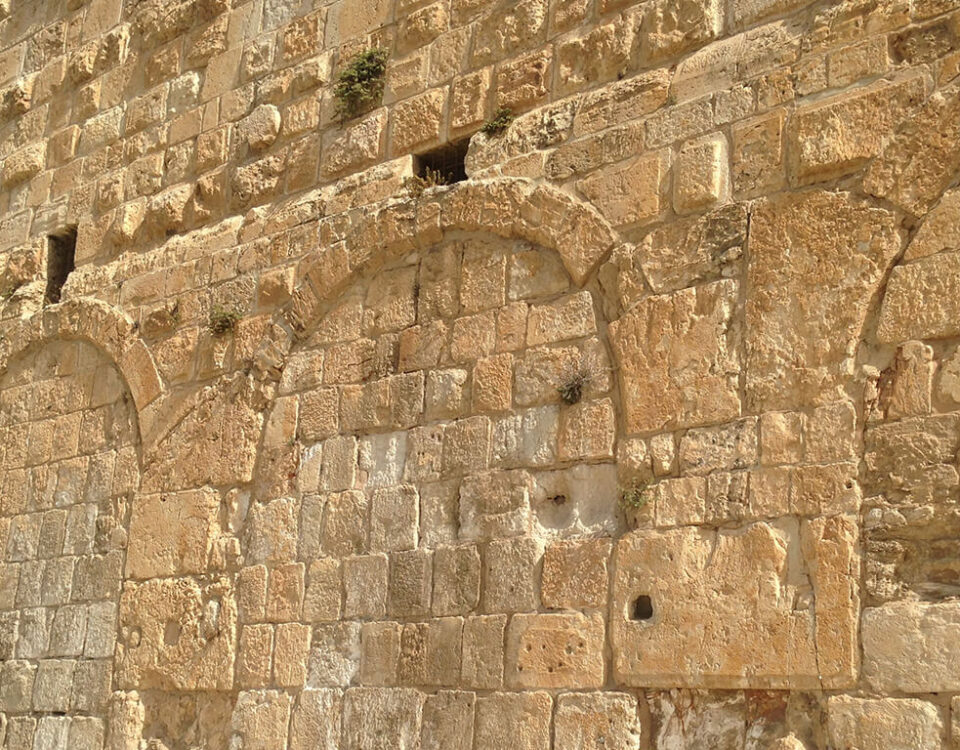
Between 1536 and 1541, the magnificent walls that still surround the Old City were rebuilt. Extending nearly four kilometers in length and exceeding twelve meters in height, these fortifications included thirty-four towers and seven gates.
In addition to constructing six public fountains throughout the city, Suleiman’s charitable wife, **Hürrem Sultan**, established a large charitable complex consisting of a mosque, madrasa, caravanserai, ribat, and public soup kitchen known as the **Haseki Sultan Imaret**. To support this institution, she endowed extensive agricultural lands and substantial financial resources, particularly in the region around Ramallah.
Ottoman rule over Jerusalem, which began in 1517, came to an end on December 9, 1917, when British forces captured the city.
During the four centuries of Ottoman administration, Jerusalem’s administrative status changed several times. Between 1516 and 1831 it was attached to the Province of Damascus; between 1841 and 1865 it belonged to the Province of Sidon; between 1865 and 1872 it formed part of the Province of Syria; and from 1872 until 1917 it functioned as an autonomous mutasarrifate directly subordinate to the central government in Istanbul.
### The British Mandate and the Modern Period
Following the First World War, Jerusalem passed from Ottoman control into British hands. In 1920, the British Mandate for Palestine was formally established.
In 1948, the State of Israel was officially proclaimed in West Jerusalem, while East Jerusalem remained under Jordanian administration. However, during the Arab-Israeli War of 1967, East Jerusalem was also occupied by Israel, resulting in Israeli control over the entire city.
In 1980, the Israeli Knesset adopted the **Jerusalem Law**, declaring Jerusalem the “complete and united” capital of Israel.
## CONCLUSION
For Muslims, Jerusalem is far more than a historical city. It is the location of the first qibla, the destination of the Prophet Muhammad’s Night Journey and Ascension, the home of al-Masjid al-Aqsa, and one of the most sacred centers of Islamic civilization.
Throughout Islamic history, Jerusalem has served as a center of worship, scholarship, spirituality, and culture. It has been revered by scholars, jurists, Sufis, rulers, and ordinary believers alike. The city's religious significance derives not only from its historical role but also from its enduring connection to revelation, prophecy, and sacred memory.
Because of its unique position in Islamic belief, Jerusalem continues to occupy a central place in the hearts of Muslims throughout the world, remaining one of the most cherished and revered cities in Islamic civilization.
# Bibliography
Ağırakça, Ahmet. *Saladin Ayyubi and the Reconquest of Jerusalem*. Istanbul: Beyan Yayınları, 1997.
Aksoy, Kemalettin. “The Virtue of al-Masjid al-Aqsa.” Accessed January 8, 2018.
Arif, Arif Pasha. *Tarikh al-Quds*. 2nd ed. Cairo: Dar al-Ma'arif, 1994.
Arslantaş, Nuh. “Why Is Jerusalem Not the Capital of the Jews?” Accessed January 8, 2018.
Avcı, Casim, Cengiz Tomar, and Kamil Jamil al-Asali. “Jerusalem.” In *Türkiye Diyanet Foundation Encyclopaedia of Islam*, vol. 26, 327–338.
Basit, Musa Ismail. *History of Jerusalem*. Istanbul: Nida Yayıncılık, 2011.
Bozkurt, Nebi. “Al-Masjid al-Aqsa.” In *Türkiye Diyanet Foundation Encyclopaedia of Islam*, vol. 29, 268–271.
Elgün, Abdullah Çağrı. *Jerusalem: The First Qibla*. Istanbul: Kültür Basın Yayın Birliği, 1991.
Erol, Halit. *The Sanctity of Jerusalem*. Istanbul: Özyurt Yayınları, 2002.
Fehd Cabir, Fayiz. *Jerusalem: Its Past, Present, and Future*. Amman: Dar al-Jalil, 1985.
Gül, Muammer. “Jerusalem and the Names It Has Received Throughout History.” *Fırat University Journal of Social Sciences* 11, no. 2 (2001): 305–312.
Gül, Muammer. “The Muslim Conquest of Jerusalem.” *Journal of Harran University Faculty of Theology* 8, no. 2 (2001): 47–58.
Hasanoğlu, Eldar. “Jerusalem in Islamic Belief.” *Fikriyat*, February 15, 2018.
*Jerusalem in the Conscience of the Islamic World*. Mecca: Muslim World League (Rabitat al-'Alam al-Islami), 1995.
Köse, Feyza Betül. “The Administrative and Social Structure of Jerusalem under Ottoman Rule.” *Belgü* 1, no. 1 (2015): 161–199.
Montefiore, Simon Sebag. *Jerusalem: The Biography of a City*. Translated by Cem Demirkan. Istanbul: Pegasus Yayınları, 2016.
Paksu, Mehmet. *Jerusalem and al-Masjid al-Aqsa*. Istanbul: Nesil Yayınları, 2000.
*Tarikh Madinat al-Quds*. Riyadh and Amman: Dar al-Karmel, 1984.
Jerusalem in Christian Belief
# Jerusalem in Christian Belief
God intervened in history in this city; the atonement for original sin was accomplished here, and through the Resurrection He demonstrated His divine power in this very place. For Christians, Jerusalem is the mysterious location where salvation from sin was achieved, the center of the created world, and the place where Christ will return for the Second Coming.
Like Judaism and Islam, Christianity also regards Jerusalem as a holy city. Christians view Jerusalem as the center of the world, the place where Adam was created and buried, and ultimately as the city that bears the traces of Jesus Christ. Throughout the world, church buildings are traditionally oriented toward Jerusalem. Furthermore, Christians believe that the altar in every church spiritually connects that congregation to the Church of the Holy Sepulchre in Jerusalem. This belief clearly demonstrates Jerusalem’s significance within Christian consciousness.
Christianity initially emerged as a sect within Judaism. Over time, through the efforts of Paul and the Church Fathers, it developed into an independent religion. This transformation was made possible by new theological doctrines centered on Jesus Christ. According to these doctrines, God became incarnate in the person of Jesus Christ in order to save humanity from original sin, was crucified and sacrificed as a ransom, and then rose from the dead before ascending into heaven. In short, Jerusalem is important because it was the setting for many of the pivotal events that shaped Christian thought—from Jesus’ childhood to His death, resurrection, and ascension.
God intervened in history in this city; the atonement for original sin was paid here, and through the Resurrection He revealed Himself here. For Christians, Jerusalem is the sacred and mysterious place where salvation from sin occurred, the center of the created world, and the location of Christ’s Second Coming.
In addition, the first Christian community emerged in this city, and the first Church was born here. Orthodox Christians regard Jerusalem as the mother of the entire Christian world. According to Christian belief, the Holy Spirit descended upon the Apostles in Jerusalem on the Day of Pentecost, and from Jerusalem the Gospel spread throughout the world. All these factors elevated Jerusalem to a unique status among Christians. Loyalty to Jerusalem is often perceived as an expression of loyalty to the humanity of Jesus Christ.
Information concerning Jerusalem appears throughout Christian sacred texts, both in the Gospels and in other books of the New Testament. The city is mentioned 146 times in the sacred scriptures. Because references to Jerusalem are generally connected with events in the life of Jesus Christ, these references are scattered throughout the Gospels. Among them, the Gospel of Luke and the Acts of the Apostles contain particularly extensive references to the city.
## JERUSALEM IN CHRISTIAN SACRED TEXTS
Matthew refers to Jerusalem as “the holy city” (Matthew 4:5). Although Jerusalem is not explicitly named in that verse, some scholars argue that the phrase was merely a conventional expression and did not carry a particular significance for Christians, while others interpret it as a reference to heaven.
Matthew explicitly mentions Jerusalem in the account of the Magi, who, after observing the star announcing the birth of Jesus in Bethlehem, traveled not directly to Bethlehem but first to Jerusalem (Matthew 2:1–3).
The Gospel of Mark begins by describing people from Jerusalem visiting John the Baptist for baptism. Beginning in chapter ten, it narrates Jesus’ arrival in Jerusalem for His ministry and the events that took place there.
In the Gospel of Luke, Jerusalem first appears in connection with Jesus being brought to the Temple after His circumcision on the eighth day, where prophecies concerning His future messianic role were proclaimed. Twelve years later, Jesus again appears in Jerusalem when He visits the Temple with His parents (Luke 2:21–22, 41–49).
In the Gospel of John, Jerusalem is first mentioned in relation to John the Baptist (John 1:19–20), and later the narrative focuses on Jesus’ journeys to Jerusalem and His ministry there.
According to Christian belief, the events that followed the crucifixion of Jesus are described in the Acts of the Apostles. These events firmly established Jerusalem at the center of Christian consciousness from the earliest period. Even Paul traveled to Jerusalem to defend himself, maintained his connection with the city, and expected Gentile Christians to show respect for Jerusalem.
The Christian concept of the Heavenly Jerusalem also originates from the sacred texts. The Jerusalem repeatedly portrayed in the Old Testament as the city of God became, in Christian theology, the basis for the idea that God’s true sanctuary exists in heaven.
Passages such as “the city with foundations, whose architect and builder is God” (Hebrews 11:10), “Mount Zion, the city of the living God, the heavenly Jerusalem” (Hebrews 12:22), and “the holy city, Jerusalem, coming down out of heaven from God, shining with His glory” (Revelation 21) form the scriptural foundation of this concept.
## JERUSALEM IN CHRISTIAN HISTORY
### The Early Period (1st–3rd Centuries)
Although Christian sacred texts contain statements regarding the importance of Jerusalem, it cannot be said that the idea of a holy Jerusalem was universally accepted during the early centuries when Christianity remained an underground faith. This debate was particularly relevant during the first three centuries. Beginning in the fourth century, however, Christianity rose to the status of an imperial religion, and pilgrimage became established as a formal religious practice.
Because Jerusalem preserved memories associated with Jesus Christ, it naturally became the primary destination of pilgrimage. For this and other reasons, historians have noted that Christian attitudes toward Jerusalem were often mixed during the early centuries. Nevertheless, because Jerusalem was remembered in Christian worship and repeatedly mentioned in the letters of Paul, it remained present in Christian consciousness.
Two distinct approaches toward Jerusalem emerged during this period. One regarded Jerusalem as historically important but not theologically sacred. The other maintained that the city remained genuinely holy.
The most influential advocate of the first position was Eusebius (d. 371), one of the greatest Christian scholars and historians of his age. He argued that the significance attributed to Jerusalem in the Old Testament had ended with the coming of Christ. According to Eusebius, Jerusalem’s former prominence in God’s plan had ceased; therefore, the city retained only historical importance and no longer possessed theological significance in the eyes of God.
This uncertainty regarding Jerusalem may have originated from the teachings of Jesus Himself, which the Church Fathers later interpreted and developed. The Gospels report that Jesus entered the Temple and expelled merchants, declaring that commercial activity was unworthy of the sacred house of God (Matthew 21:12; Mark 11:15; Luke 19:45; John 2:13–16). This clearly indicates that Jesus regarded the Temple as holy.
At the same time, Jesus emphasized that the Son of Man held a greater significance than the Temple itself. When asked for a sign, He declared that the Temple could be destroyed and rebuilt in three days, referring metaphorically to His own body (John 2:18–22).
Likewise, at the moment of Jesus’ crucifixion, the veil of the Holy of Holies was torn in two (Matthew 27:51; Mark 15:38; Luke 23:44), exposing what had previously been hidden from all but the High Priest. For many Church Fathers, these events demonstrated that the significance of the Temple had ended and that Jesus Himself had become the true sanctuary.
Furthermore, Jesus told the Samaritan woman that the time was coming when people would no longer worship God specifically in Jerusalem (John 4:21). He also predicted the destruction of Jerusalem because the city failed to recognize the time when God visited it (Luke 19:44). These statements reinforced the belief that Jerusalem's unique religious status had come to an end.
Because Christianity emerged within Judaism, it initially inherited Jewish concepts of sacred space. For Jews, the Land of Israel, Jerusalem, the Temple, and the Holy of Holies represented progressively greater degrees of sanctity. Christianity, however, transferred this sanctity to Jesus Christ Himself.
The Holy of Holies lost its unique status when its veil was torn; the Temple lost its significance when Jesus identified Himself as the true Temple; and Jerusalem lost its role as God's city because it failed to recognize God's visitation. Consequently, the Holy Land itself also lost its unique sacredness, and for Christians, only Jesus Christ ultimately remained truly holy.
## DEVELOPMENTS IN THE FOURTH CENTURY AND THE IMPORTANCE OF JERUSALEM
In its early stages Christianity was viewed as a heretical movement within Judaism. Through Paul's missionary efforts it spread among the Gentiles, and by the end of the first century it had begun to emerge as a separate religion. Since the Roman Empire remained pagan, Christians were persecuted by imperial authorities.
The Edict of Milan in 313 ended these persecutions, and by the 380s Christianity had become the sole legitimate religion of the Roman Empire. These developments profoundly transformed Christian institutions and practices, including pilgrimage.
Because Christians had been persecuted during the first centuries, a well-defined concept of sacred places had not fully developed. Since Christian scriptures did not require pilgrimage, the earliest Christians did not practice it. Jesus had taught that true worship would occur neither on Mount Zion nor in Jerusalem but “in spirit and in truth.” Consequently, Christians initially attached no special religious significance to locations associated with Jesus, the prophets, or the Church Fathers.
This perception changed after the pilgrimage of Helena, mother of Emperor Constantine, to the Holy Land in 326. Regarded as the first Christian pilgrim, Helena is traditionally credited with discovering the True Cross upon which Jesus was crucified.
Her journey created conditions favorable to a complete reversal of earlier negative views regarding Jerusalem’s sanctity. Church Fathers increasingly considered visits to Jerusalem and its surrounding sacred sites beneficial because they strengthened religious devotion.
As the city bearing the traces of Jesus Christ, Jerusalem gradually came to be regarded as holy and developed into one of Christianity’s foremost pilgrimage destinations. Although many early Church Fathers had discouraged pilgrimage, Christian pilgrims continued to visit Jerusalem, and opposition to such journeys largely disappeared by the fourth century.
During the Byzantine period especially, Christian pilgrims demonstrated profound reverence toward the lands where their faith originated. Pilgrims traveled from across the world to visit sacred shrines and, above all, the newly identified tomb believed to belong to Jesus Christ. Despite earlier objections, Jerusalem gradually regained its sacred status among Christians.
Saint Cyril of Jerusalem (d. 444) argued that although Jerusalem’s ancient divine significance belonged to the past, it had certainly not ended. He pointed out that crucial events concerning Jesus Christ and the Holy Spirit had occurred there, and argued that these events demonstrated that Jerusalem remained important in God's eyes. To support this position, he interpreted Matthew’s reference to “the holy city” as referring specifically to contemporary Jerusalem.
Cyril considered Jerusalem’s holiness independently of historical events, arguing that the city was not holy merely because significant events occurred there, but because it possessed genuine theological significance and remained uniquely sacred to God. He maintained that Jerusalem deserved a natural primacy throughout the Christian world.
Thus, pilgrimage became firmly established within Christianity. Its purpose was to preserve and relive memories associated with Jesus Christ and the Holy Spirit. Jerusalem acquired unique religious significance because it contained locations connected with Jesus’ entry into the city, His preaching, His path to crucifixion, His burial, His resurrection, and His appearances to the Apostles.
These places became especially sacred because of their direct association with Christ. Since they contained the traces of God's incarnation and the very footprints of God upon the earth, they served as reminders of the God whom Christians believe once walked among humanity.
Pilgrimage to Jerusalem consists largely of visiting these sacred sites, which provide tangible evidence of Christian faith. Through them, believers become living witnesses to the events described in scripture.
Pilgrims relive the final days of Jesus by following the Via Dolorosa—the Way of Sorrows—along which He carried His cross. For much of the Christian world, this is the most important street on earth and the principal route of pilgrimage. Located within Jerusalem’s Old City, it consists of fourteen stations, the last four situated inside the Church of the Holy Sepulchre. Many pilgrims walk this route carrying crosses on their shoulders in order to share symbolically in Christ’s suffering.
Another site of exceptional significance is Golgotha, the Place of the Skull, where Jesus was crucified.
According to Christian tradition, when a soldier pierced Jesus’ side with a spear after His death, blood and water flowed onto the ground. Christians believe that this site marks the center of the world, the place where Adam was created and buried, and that Christ’s blood fell upon Adam’s skull beneath the cross, thereby cleansing humanity’s original sin.
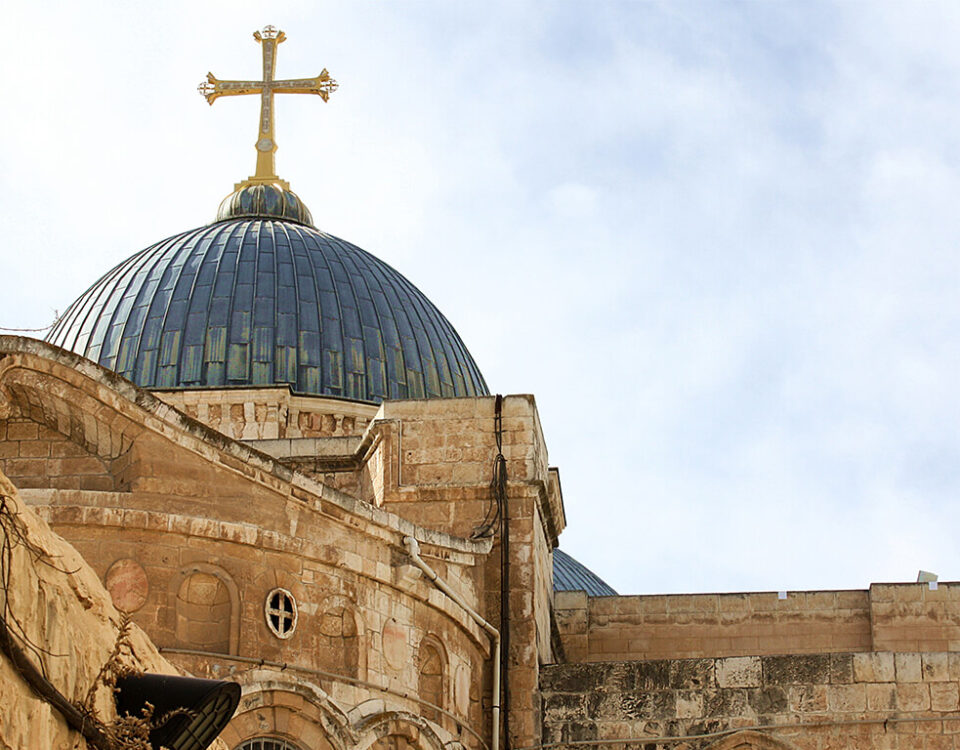
Perhaps the holiest pilgrimage site in Jerusalem is the Church of the Holy Sepulchre, also known as the Church of the Resurrection. Christians believe that it contains the tomb of Jesus Christ. Although opinions differ regarding its construction, the most widely accepted view is that it was built between 326 and 335 following Helena’s visit to Jerusalem.
Following the Council of Chalcedon (451), the church was divided among various Christian denominations. Over time, different groups occasionally gained dominance within the sanctuary. After the Crusades and the eventual Muslim reconquest of the region, the church and its possessions were allocated among several Christian communities, including Roman Catholics, Greek Orthodox, Armenians, Syriacs, Copts, and Ethiopians.
The belief in the holiness of the site and its relics, combined with the desire to possess more sacred space and objects, often generated rivalry among these communities and at times even led to open conflict.
## THE CRUSADES AND THE LATIN KINGDOM OF JERUSALEM
Jerusalem was conquered by the Muslims in 638. According to tradition, Patriarch Sophronius declared that he would surrender the city only to the Caliph himself. Consequently, Caliph Umar personally traveled to Jerusalem and, through the Covenant of Umar, guaranteed the religious freedom of the city’s Christian inhabitants.
For centuries thereafter, Christians living in Palestine continued their existence under Muslim rule as protected communities (*dhimmis*).
The advance of the Turks into Anatolia following the Battle of Manzikert alarmed Christian powers. In response, armies from Europe marched toward the Middle East. To recruit soldiers for what became known as the Crusades, religious sentiments were deliberately stirred. Christians were told that they were setting out to protect pilgrims and liberate Jerusalem from “infidel” Muslim control.
The Pope described the campaign as a holy war, and Christians were convinced that religion was the primary motivation behind the Crusades.
One papal appeal declared:
> “Jerusalem is the navel of the world. More fertile than all other lands, it is like a second paradise of delight. The Savior of mankind made it glorious by His birth, adorned it by His life, sanctified it by His suffering, redeemed it by His death, and sealed it by His burial. This noble city, situated at the center of the world, is now held captive by its enemies. It has been enslaved by a people who do not acknowledge God. Therefore, it longs for liberation and calls upon you without ceasing to come to its aid.”
The Crusaders captured Jerusalem on 15 July 1099 and established the Latin Kingdom of Jerusalem. Muslim inhabitants were massacred, while many Eastern Christians were expelled, apparently because of sectarian differences.
Jerusalem became the capital of the Latin Kingdom, and a church loyal to the Papacy was established there. Godfrey of Bouillon, the kingdom’s first ruler, refused the title of king out of humility, believing that Jesus Christ alone was the true King of Jerusalem. Instead, he adopted the title “Defender of the Holy Sepulchre.” His brother Baldwin I, who succeeded him in 1100, assumed the royal title.
On 2 October 1187, Salah al-Din (Saladin) recaptured Jerusalem from the Crusaders and restored Christian holy places to their traditional custodians. Although the Crusaders briefly regained the city in 1229, they were forced to relinquish it again in 1244.
Jerusalem would not return to Christian control until centuries later, when British forces occupied the city on 9 December 1917.
**Assoc. Prof. Dr. Eldar Hasanoğlu – Beyaz Tarih**
Hasanoğlu, Eldar. “Jerusalem in Christian Belief.” *Beyaz Tarih*. Published January 18, 2018. Accessed July 14, 2026. Originally published at Fikriyat.
Hasanoğlu, Eldar. “Hristiyan İnancında Kudüs.” *Fikriyat*, January 18, 2018.
Jerusalem According to Jewish Belief
# Jerusalem According to Jewish Belief
Although Jerusalem is not mentioned by name in the narrative of Prophet Abraham (Ibrahim), who is regarded as the forefather of the Israelites, it remained an ordinary city for the Israelites during the time of Prophet Moses (Musa) and for approximately two hundred years thereafter. How, then, did Jerusalem become transformed into the metaphor of a holy city for the Israelites, and why is it important for Jews?
Jerusalem, which is considered both the holy city and the qibla of the Jews, initially gained importance in a political context and only later became sanctified. This process of sanctification reached its culmination during the Babylonian Exile. Jerusalem occupies a special place in the literature of both this period and the periods that followed. All these narratives polished and magnified the significance of Jerusalem in the Jewish consciousness. Centuries later, the Zionists appealed to and benefited from this mentality in an effort to unite Jews around the world under their banner. Considering that “Zion” is one of the names of Jerusalem, it becomes evident that the term “Zionism” can also be understood as meaning “Jerusalemism.”
## HOW DID JERUSALEM BECOME HOLY?
Within the Jewish sacred scriptures, Jerusalem is not mentioned by name in the Torah, the section attributed to Prophet Moses. The city appears by name only in the later sections known as Nevi’im (Prophets) and Ketuvim (Writings), which contain revelations given to subsequent prophets.
Jerusalem is not mentioned by name even in the account of Prophet Abraham, who is regarded as the ancestor of the Israelites. Archaeology has not yet confirmed the events in Abraham’s story that are interpreted as referring to Jerusalem. During the time of Moses and for approximately two hundred years afterward, Jerusalem remained an ordinary city in the eyes of the Israelites. According to Jewish sources, Joshua, the successor of Moses, captured the city but left it in the hands of the indigenous tribe known as the Jebusites. Had Jerusalem been viewed as a privileged and important city, it may be argued that Joshua would not have left it to the local inhabitants.
Jerusalem entered the agenda of the Israelites beginning with the time of King David. Until then, it had remained under Jebusite control. The city gained religious significance for the Israelites through David and Solomon, and the first steps toward its sanctification were taken during their era. David captured the city and made it his capital. His choice of Jerusalem as the capital was based on political and strategic considerations, as it allowed him to maintain balance among the Israelite tribes. During the reign of David’s son Solomon, the construction of the Temple was completed, and Jerusalem began to acquire a religious meaning. It thus emerged not only as a political center but also as a religious center.
Nevertheless, the Israelites did not immediately regard Jerusalem as holy. This perception gradually took root among the Jewish people over time. During the First Temple Period, which lasted from Solomon’s reign until 586 BCE, Jerusalem was progressively sanctified, and this perception was completed during the Second Temple Period.
According to the Hebrew Bible, after the death of Solomon, the Israelites strayed from the true path and worshipped idols and local deities. Consequently, Jerusalem did not become more than a city containing Solomon’s Temple. Moreover, the Temple itself held little special significance for many Israelites during this period. Instead, they worshipped at alternative sanctuaries known as bamot (high places).
The sanctification of Jerusalem took place during the reigns of Hezekiah (727–697 BCE) and Josiah (640–609 BCE). They believed that strengthening the state required channeling the people’s religious sentiments toward Jerusalem. Based on the idea that acceptable worship could only be conducted in Solomon’s Temple, they launched a campaign against the bamot. As a result of this struggle, the high places that were seen as alternatives to Solomon’s Temple were quickly eliminated. Thus, a close reading of the biblical text suggests that Jerusalem’s rise to religious prominence among the Israelites was actually the outcome of a worldly political plan aimed at centralization. This issue should therefore be understood within the framework of the relationship between religion and politics in that era.
The final stage of sanctification occurred with the Babylonian Exile in 586 BCE. Life in exile reinforced the idea of Jerusalem’s holiness among the Israelites. In other words, Jerusalem became truly privileged and sacred only after it had been lost. Up until that point, Jerusalem had been the capital of the Kingdom of Judah and was primarily significant for its own citizens. During the exile, however, it came to symbolize the homeland and gradually transformed into a spiritual center for all Jews.
Jews living in the Diaspora expressed their longing for their homeland through Jerusalem. In this way, the sanctification of Jerusalem reached its peak. This climax is reflected in the Bible through the words of the exiled people sitting by the rivers of Babylon:
> “If I forget you, O Jerusalem, may my right hand lose its skill. May my tongue cling to the roof of my mouth if I do not remember you, if I do not consider Jerusalem my highest joy.” (Psalm 137)
## JERUSALEM AS A HOLY CITY
The sections of the Hebrew Bible known as Nevi’im and Ketuvim contain information regarding the stages of Jerusalem’s sanctification and the praises expressed during this process. Particular sensitivity was shown in the literature of the Second Temple Period to establish the holiness of Jerusalem within society. Especially from the middle of the Tannaitic period (1st–2nd centuries CE), when the Temple had been destroyed, Jerusalem became a focal point of attention for Jewish scholars.
After the suppression of the Bar Kokhba Revolt in 132 CE, Jews were expelled from Jerusalem. In this environment, religious scholars spoke extensively about the virtues of residing in the city.
## JERUSALEM IN JEWISH SACRED TEXTS
The Hebrew Bible contains numerous names and descriptions used to refer to the city of Jerusalem. The most important of these is the name *Yerushalayim* (Jerusalem). In addition, names and designations such as Moriah (II Chronicles 3:1), Jebus (Judges 19:10), Zion, the City of David (II Samuel 5:7, 9; I Chronicles 11:5, 7), Ariel (Isaiah 29:1), the Habitation of Righteousness (Jeremiah 31:23), the Faithful City, the City of Peace, the City of Righteousness (Isaiah 1:26), the City of God (Psalms 46:4), the City of the Lord of Hosts (Psalms 48:8), and the Holy City (Nehemiah 11:18) are also used. The Arabic name of the city, *al-Quds*, is likewise derived from the expression “Holy City” found in Nehemiah 11:18.
According to the Hebrew Bible, there is a special bond between Yahweh and Jerusalem. It is stated that God chose this city as His own and that His presence would dwell there forever. The passage, “The Lord dwells in Zion,” expresses this idea. The Bible emphasizes that God will always be present in Jerusalem and has attached His name to the city.
The Hebrew Bible also describes Jerusalem as the place where thrones of judgment are established. This indicates that Jerusalem, because of its connection with Yahweh, was perceived as a center from which justice is dispensed. Jeremiah’s declaration reinforces this understanding:
> “At that time they will call Jerusalem ‘The Throne of the Lord,’ and all nations will gather in Jerusalem to honor the name of the Lord. No longer will they follow the stubbornness of their evil hearts.” (Jeremiah 3:17)
Likewise, Jeremiah’s statement:
> “Jerusalem will live in safety, and this is the name by which it will be called: ‘The Lord Our Righteousness.’” (Jeremiah 33:16)
can be viewed as a metaphor for the city’s association with justice. A similar approach appears in Isaiah, who describes Jerusalem as the City of Righteousness. These expressions demonstrate that Jerusalem, regarded as the eternal dwelling place of the just Yahweh, became in Judaism a symbol of integrity and the earthly center for the distribution of justice and truth.
In many passages of the Hebrew Bible, references to Jerusalem actually imply the entirety of the land of Judah. This has been interpreted as evidence that Jerusalem was not merely an ordinary city but a concept embodying centrality. In this context, expressions such as “Daughter of Jerusalem” or “Daughter of Zion” are understood to represent the whole kingdom and the entire Jewish people.
However, it should not be forgotten that this centrality and inclusiveness did not always manifest positively. When the sins and wrongdoing of the Israelites are described, the biblical texts often attribute these evils metaphorically to Jerusalem itself. Thus, while Isaiah’s writings elevate Jerusalem to the heavens and endow it with extraordinary qualities, certain passages in Jeremiah contain criticism and reproach directed toward Jerusalem because of idolatry. In this way, a balance is maintained within the scriptural narrative.
In texts from the period of exile, themes of longing and expectation regarding Jerusalem come to the forefront. For example, Jeremiah prophesies that Jerusalem will be rebuilt and that voices of thanksgiving and joy will once again be heard there. Similarly, Zechariah states that Yahweh is jealous for Zion, that He will return and dwell in Jerusalem, that Jerusalem will be called the City of Truth, that elderly people will sit in its squares, and that its streets will be filled with children playing.
When Ezekiel describes his vision of Jerusalem, he portrays the city with extraordinary detail. In his account, Jerusalem is not an ordinary city, nor even merely a royal capital, but a possession uniquely belonging to God. For this reason, every detail is elaborated upon, and intricate descriptions of Jerusalem are provided.
The Hebrew Bible also contains eschatological teachings concerning Jerusalem. According to these prophecies, a time will come when Yahweh, sovereign over all things, will reign on Mount Zion in Jerusalem; then the moon will be ashamed and the sun disgraced before His glory. On that day a great trumpet will sound, and those lost in the Assyrian exile together with those scattered in Egypt will come and worship Yahweh on the holy mountain in Jerusalem.
Elsewhere, through the words of Isaiah, God consoles Jerusalem:
> “O afflicted city, lashed by storms and not comforted, I will rebuild you with stones of turquoise, lay your foundations with sapphires, make your battlements of rubies, your gates of sparkling jewels, and all your walls of precious stones.”
Likewise, it is declared that Jerusalem will become holy, that foreigners will never again conquer it, that it will endure from generation to generation, and that the guilty will be punished. The words,
> “On that day I will shield those who live in Jerusalem... On that day I will set out to destroy all the nations that attack Jerusalem.”
express the promise that Yahweh will ultimately restore Jerusalem to the Jews and keep alive the hopes of the Jewish community.
## JERUSALEM IN RABBINIC SOURCES
For the rabbis, Jerusalem represented far more than a place of historical or geographical significance. It became a source of hope and a motivation for perseverance in the face of countless hardships. Just as God and the Torah are said to possess seventy names, Jerusalem too is said to have seventy names. In this context, the symbolic importance of the number seventy within Semitic culture should not be overlooked.
The legal rulings concerning Jerusalem generally aim to preserve its purity, cleanliness, and privileged status. Regardless of where they may live, Jews are required to face Jerusalem while praying, for the city is almost synonymous with God Himself. God is not only the builder of Jerusalem (*Bone Yerushalayim*), but also the One who dwells within it (*Shokhen Yerushalayim*).
Jewish sages taught that the Land of Israel (*Eretz Yisrael*) is the center of the world, and that Jerusalem is the center of the Land of Israel. According to the rabbis, Jerusalem possesses a unique order and extraordinary qualities. They taught that when God created the world, He divided beauty into ten portions and bestowed nine of them upon Jerusalem.
The rabbis also declared that the gate of heaven is Jerusalem, that the entire world was created from Zion, and that the soil from which Adam was fashioned was taken from Jerusalem. The holiness of Jerusalem is safeguarded directly by God Himself; therefore, many worldly pleasures found in surrounding cities are absent from Jerusalem.
Rabbinic literature also contains highly exaggerated descriptions, such as claims that no one will be injured in Jerusalem, that no fire will burn anything within the city, and that no earthquake will destroy its houses. It is further stated that those who live in Jerusalem receive divine forgiveness twice each day.
In our view, these statements reflect a desire to gather Jews, who had been dispersed to different regions during difficult times, back to Jerusalem. Although the destruction of the Temple in 70 CE and the fall of Jerusalem had a profoundly negative impact on the Jewish people, the rabbis sought to keep hope alive through such interpretations.
Within this context, themes such as the future coming of the Messiah, the Jews regaining Jerusalem and establishing a state, and the restoration of Jerusalem to its former glory were frequently emphasized by the rabbis. They even elaborated on these expectations in remarkable detail.
Jerusalem’s exalted position also gave rise to the concept of the Heavenly Jerusalem in rabbinic thought. Mystics believed that the earthly world was a reflection of the heavenly realm at the time of creation. Consequently, the rabbis maintained that Jerusalem exists both in heaven and on earth, and that although the earthly Temple had been destroyed, the heavenly Temple continued to exist.
Apocalyptic writings further state that at the end of time, the Heavenly Jerusalem and its Temple will descend and be established upon the earth.
Jerusalem occupies a central place in Jewish worship and prayer. As the direction of prayer, all Jews are required to face Jerusalem during worship. The city is remembered constantly in daily prayers. The fourteenth blessing of the daily Amidah prayer is devoted entirely to Jerusalem. It begins with the words:
> “May Jerusalem, the city of mercy, be rebuilt in our days...”
and concludes:
> “Blessed are You, O God, Builder of Jerusalem.”
The prayer recited on Tisha B’Av mentions “those who mourn for Jerusalem,” and many other prayers emphasize the theme of Jerusalem’s future restoration.
## CONCLUSION
The sanctification of Jerusalem within Judaism was not an instantaneous development but rather the result of a long historical process. Initially significant for political and strategic reasons, Jerusalem gradually acquired religious significance through the reigns of David and Solomon. The centralization policies pursued during the reigns of Hezekiah and Josiah further elevated its status, while the Babylonian Exile transformed it into the ultimate symbol of homeland, identity, and spiritual longing.
Both the Hebrew Bible and later rabbinic literature depict Jerusalem as the city chosen by God, the center of justice, the focal point of worship, and the place where divine promises will ultimately be fulfilled. Through centuries of exile, suffering, and dispersion, Jerusalem remained at the heart of Jewish religious consciousness, serving as a source of hope and a symbol of eventual redemption.
The city’s religious, historical, and symbolic significance shaped not only Jewish theology and liturgy but also later ideological movements such as Zionism, which drew heavily upon the deeply rooted attachment of the Jewish people to Jerusalem. Thus, Jerusalem continues to occupy a unique and central place in Jewish faith, memory, and aspiration.
# Bibliography
Abramsky, Shmuel, and Jacob Liver. “Jerusalem: In the Bible.” In *Encyclopaedia Judaica*. 2nd ed. Vol. 11, 208–210.
Armstrong, Karen. “The Holiness of Jerusalem: Asset or Burden.” *Journal of Palestine Studies* 27, no. 3 (1998): 5–19.
Avot de-Rabbi Nathan. Edited by Solomon Schechter. Vienna, 1887.
Cline, Eric H. *Jerusalem Besieged: From Ancient Canaan to Modern Israel*. Ann Arbor: University of Michigan Press, 2005.
Gafni, Yeshayahu. “The Status of the Land of Israel in Jewish Consciousness Following the Bar Kokhba Revolt.” In *Bar Kokhba Revolt: New Studies*, edited by A. Oppenheimer and A. Rapoport, 224–232. Jerusalem: Yad Yitzhak Ben-Zvi, 1984.
Harman, Ömer Faruk. “Jerusalem.” In *TDV Encyclopedia of Islam*. Vol. 26, 323–327.
Hasanoğlu, Eldar. “The Process of the Sanctification of Jerusalem According to the Tanakh.” *Journal of the Faculty of Theology of Uludağ University* 24, no. 2 (2015): 123–146.
Josephus, Flavius. *The Complete Works of Josephus*. Edited by William Whiston et al. New York: Bigelow Brown, n.d.
Kroyanker, David. *Jerusalem: Neighborhoods and Houses, Periods and Styles*. Jerusalem: Keter, 2006.
Midrash Rabbah. Edited by H. Freedman and Maurice Simon. 10 vols. London: Soncino Press, 1939.
Midrash Tehillim. Edited by Solomon Buber. Vilna, 1891.
Midrash Tanhuma. Edited by Solomon Buber. Translated by John T. Townsend. New Jersey: Ktav Publishing House, 1989.
Nir, Rivka. *Jerusalem Through the Ages I: From a Jebusite City to the Capital of the People of Israel*. Raanana: Open University of Israel, 1984.
Oded, Bustenay. *History of the People of Israel in the First Temple Period I: The United Monarchy*. Raanana: Open University of Israel, 2007.
Pesikta de-Rav Kahana. Edited by Solomon Buber. Lyck, 1868.
Safrai, Zeev, and Hanna Safrai. “The Holiness of the Land of Israel and Jerusalem: Lines in the Development of the Idea.” In *Jews and Judaism in the Days of the Second Temple, the Mishnah and the Talmud*, edited by Aharon Oppenheimer et al. Jerusalem: Yad Yitzhak Ben-Zvi, 1993.
Shur, Natan. *History of Jerusalem I: From the Pre-Israelite City to the Byzantine Period*. Tel Aviv: Devir, 1987.
*Tanna Debe Eliyahu: The Lore of the School of Elijah*. Translated by William G. Braude and Israel J. Kapstein. Philadelphia: Jewish Publication Society of America, 1981.
*The Zohar*. 2nd ed. Translated by Harry Sperling, Maurice Simon, and Paul P. Levertoff. 5 vols. London: Soncino Press, 1984.
Yiğitoğlu, Mustafa. “The Temple Policy of the Jews and the Heavenly Temple.” *Journal of Turkish Theological Studies* 1, no. 1 (2017): 43–52.
Yalkut Shimoni: Midrash on the Torah, Prophets, and Writings. Warsaw, 1877.