Jerusalem in Islamic Belief
# Jerusalem in Islamic Belief
The city of Jerusalem, which serves as the meeting point of the three Abrahamic religions founded upon divine revelation, holds a unique significance for each of these faiths. The fact that the paths of the prophets, who were the leaders of monotheistic belief, intersected in this city and that they spent at least part of their lives there has further enhanced its sanctity and value in the eyes of humanity. In this final article of the series, the meaning and significance of Jerusalem for Muslims will be examined in detail, thereby completing this series of articles devoted to the importance of Jerusalem in the three Abrahamic religions.
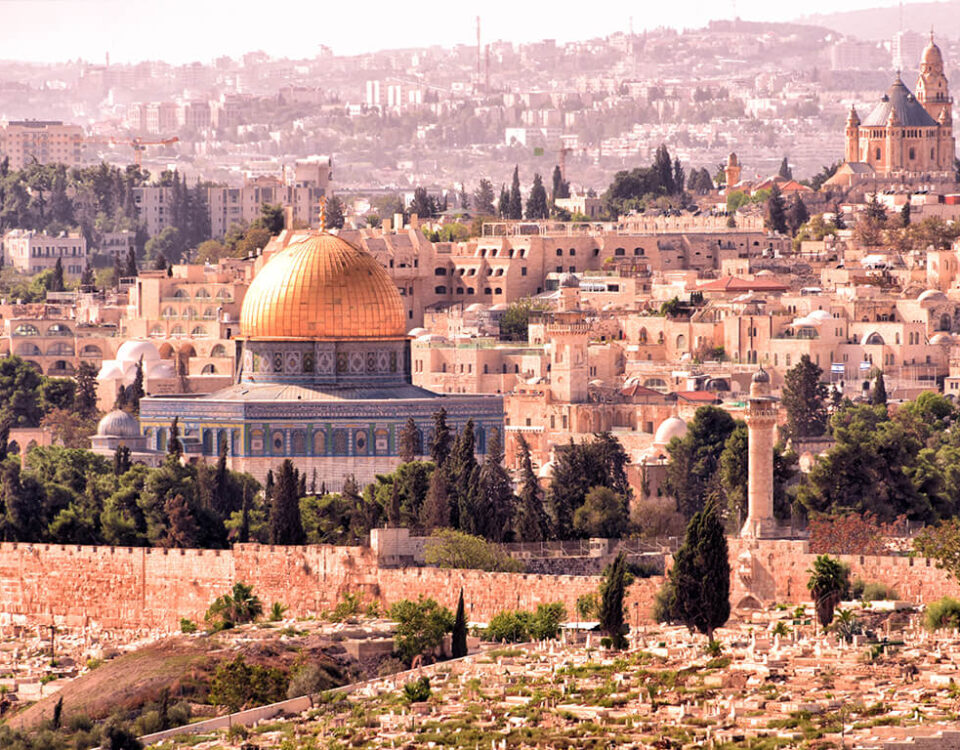
Names such as **al-Quds** (“The Holy”) and **Bayt al-Maqdis** or **Bayt al-Muqaddas** (“The Holy House”), which refer respectively to the city and the sanctuary located there, are among the most common names used in Islamic sources for Jerusalem. The walled sacred precinct that contains **al-Masjid al-Aqsa**, believed to have been built on the site of Solomon’s Temple, and the **Dome of the Rock**, constructed over the rock upon which the Prophet Muhammad (peace be upon him) is believed to have stepped during the Night Journey and Ascension, is known as **al-Haram al-Sharif** (the Noble Sanctuary).
Jerusalem occupies a special position in Islam and is regarded as a sacred city. The primary reasons for this distinction are that it was the first qibla (direction of prayer) of the Muslims and that it witnessed the Prophet’s (peace be upon him) miracles of al-Isra and al-Mi‘raj. Muslims performed their prayers facing Jerusalem until the sixteenth month after the Hijrah. Jerusalem, which is alluded to in numerous Qur’anic verses, was praised by the Prophet Muhammad (peace be upon him), who described it as “one of the three blessed places to which a journey may be undertaken.”
The blessed status of this region is attributed to the divine wisdom of God, who caused many prophets to live, preach, die, and be buried there, as well as to the natural abundance of its fruits and crops. Throughout Islamic history, Jerusalem served as a major center of learning and spirituality. Prominent scholars such as **‘Abd al-Rahman al-Awza‘i**, **Sufyan al-Thawri**, **Layth ibn Sa‘d**, and **Muhammad ibn Idris al-Shafi‘i** taught and trained students in Jerusalem. Likewise, scholars such as **Imam al-Ghazali**, **Ibn Qaysarani**, and **Abu Bakr Ibn al-‘Arabi** resided and lectured there. Renowned Sufi masters including **Rabi‘a al-‘Adawiyya**, **Bishr al-Hafi**, and **Sari al-Saqati** lived in the city and contributed greatly to its spiritual flourishing.
## JERUSALEM IN THE QUR’AN AND HADITH
Jerusalem is not mentioned by name in the Qur’an. However, it is referred to indirectly in more than ten verses. In addition, Jerusalem is the subject of numerous sayings (hadiths) of the Prophet Muhammad (peace be upon him). Both the Qur’anic references and the hadith literature indicate that Jerusalem’s sanctity is closely connected to the sacred sanctuary located within it.
Among the verses most directly associated with Jerusalem is the opening verse of Surat al-Isra:
> “Glory be to Him who took His servant by night from al-Masjid al-Haram to al-Masjid al-Aqsa, whose surroundings We have blessed, in order to show him some of Our signs. Indeed, He is the All-Hearing, the All-Seeing.” (Qur’an 17:1)
Classical Qur’anic commentators have interpreted this verse as evidence for the Prophet’s Night Journey (Isra) and Ascension (Mi‘raj).
Among other verses associated with Jerusalem is the statement concerning the Prophet Zechariah:
> “Then he came out to his people from the sanctuary and signaled to them to glorify God morning and evening.” (Qur’an 19:11)
Another example is the verse:
> “And when the second promise came to pass, We sent your enemies against you to disgrace you and to enter the Mosque as they had entered it before, and to destroy completely whatever they conquered.” (Qur’an 17:7)
Numerous hadiths describe the virtues and importance of al-Masjid al-Aqsa. Its significance is especially connected to the events of al-Isra and al-Mi‘raj. Qur’anic commentators have consistently maintained that the sanctuary visited by the Prophet during the Night Journey was Bayt al-Maqdis.
Indeed, in the famous narration of the Isra, the Prophet said:
> “I mounted al-Buraq and arrived at Bayt al-Maqdis in Jerusalem…”
The hadiths indicate that the Prophet led the assembly of prophets in prayer there before ascending to the highest heavens.
The Prophet also taught that the first mosque established on earth was the Kaaba and that the second was al-Masjid al-Aqsa. He further stated that journeys undertaken specifically for worship should be directed only to three mosques: the Sacred Mosque in Mecca, the Prophet’s Mosque in Medina, and al-Masjid al-Aqsa.
In another hadith, he explained that the greatest reward for prayer is attained in the Kaaba, followed by prayer in the Prophet’s Mosque and then prayer in al-Masjid al-Aqsa. He encouraged Muslims to visit al-Masjid al-Aqsa and perform prayers there, and advised those unable to travel to contribute olive oil for the lamps of the sanctuary.
## THE MUSLIM CONQUEST OF JERUSALEM
Jerusalem came under Muslim rule during the caliphate of Umar ibn al-Khattab. At that time, the region of Palestine was under Byzantine control. Following the Battle of Ajnadayn (13 AH / 634 CE), the first major engagement between the Muslims and Byzantines, the gates of Syria and Palestine were opened to the Muslims. With the decisive Muslim victory at the Battle of Yarmuk (15 AH / 636 CE), Syria was taken from Byzantine control, and the conquest of Palestine began.
Jerusalem was besieged by Abu Ubaydah ibn al-Jarrah, but the city's formidable walls prevented its immediate capture. The Muslim soldiers were fully aware that the city they had surrounded was no ordinary place. Abu Ubaydah maintained the siege until the inhabitants of Jerusalem became exhausted. Unable to withstand the hardships of the prolonged blockade and recognizing that they had no alternative but surrender, the Christian residents sought safe conduct from the Muslims and proposed an agreement. However, they stipulated that the city would be surrendered only to the Caliph himself.
Abu Ubaydah informed Caliph Umar of the situation and invited him to Jerusalem. Umar gathered the leading Companions of the Prophet and consulted them regarding the matter. During these discussions, both Ali ibn Abi Talib and Umar himself argued that it would be beneficial for the Caliph to travel personally to Jerusalem.
Eventually, Umar departed from Medina and journeyed to Jerusalem, where he formally received the city's surrender from Patriarch Sophronius and signed the treaty. Thus, Jerusalem entered Muslim rule without bloodshed. The inhabitants were granted guarantees for the safety of their lives, property, churches, and institutions.
This document, which became famous in Islamic history as the **Covenant of Umar**, later served as a model for Muslim conduct toward non-Muslim populations in conquered territories. Indeed, when Sultan Mehmed II conquered Constantinople centuries later, he issued similar guarantees to the city's Christian and Jewish inhabitants.
Although historical sources differ regarding the exact date of the conquest, placing it in either 16, 17, or 18 AH, the strongest opinion suggests that it occurred at the end of 17 AH or the beginning of 18 AH. Umar's entry into Jerusalem corresponds to the year 638 CE.
The Roman name of the city, **Aelia Capitolina**, was replaced by the name **Jerusalem (al-Quds)**, and **Ubadah ibn al-Samit** was appointed as judge and governor in order to teach Islam to the population.
### Accounts of Umar's Justice
Historical sources preserve numerous anecdotes concerning Umar's justice and humility during the conquest of Jerusalem.
According to one report, Umar and his servant alternated riding a single mount. As they approached Jerusalem, it happened to be the servant's turn to ride. Although the servant insisted that Umar should ride instead, Umar refused, thereby teaching a lesson in humility to those who had come out to welcome him.
Another famous account relates that while Umar was meeting with Christian leaders inside the Church of the Holy Sepulchre, the time for the noon prayer arrived. Umar asked the Patriarch to designate a place where he could pray. The Patriarch offered the church itself, but Umar declined. Instead, he moved a short distance away, spread his cloak upon the ground, and led the Muslim soldiers in prayer.
A mosque was later constructed on the site where Umar prayed, and it still exists today. Umar explained his decision by saying:
> "If I pray here, future Muslims may claim: 'Umar prayed here,' and they will convert this church into a mosque."
Through this action, he demonstrated respect for the religious beliefs and sacred places of Christians.
Another celebrated narrative concerns Umar's discovery of the location of Solomon's Temple. Sources preserve two versions of this story.
According to one account, Umar asked Patriarch Sophronius to show him the location of the Temple. Upon arriving, he found the site covered with refuse and used as a dumping ground. Umar spread his cloak, began gathering the rubbish, and personally carried it away. Inspired by his example, the Muslims joined him, and after the area was cleaned, a mosque was built there. The present site of al-Aqsa Mosque is traditionally associated with Umar's mosque.
Another version states that the exact location of the Temple had been forgotten. During his investigations, Umar concluded that a place being used by local women as a rubbish dump marked the Temple's location. He reportedly scattered a purse of gold coins over the site, causing local idlers to flock there in search of treasure. Their digging eventually revealed the remains of the Temple. Interestingly, a similar story is also attributed to Sultan Suleiman the Magnificent.
Other traditions relate that the Patriarch of Jerusalem first brought Umar to the Church of the Holy Sepulchre, hoping that Muslims would adopt it as their principal sacred site. Umar, however, declared that this was not the place from which the Prophet Muhammad ascended during the Mi'raj. He eventually identified the location now occupied by al-Masjid al-Aqsa.
Following the conquest, Muslims devoted considerable effort to the development and beautification of the city. Without sparing expense, they constructed numerous buildings of great artistic and architectural value. The special care shown toward Jerusalem by Muslims can also be seen in the fact that Caliph Uthman endowed the revenues of the Silwan Gardens for the benefit of the city's poor.
## JERUSALEM THROUGHOUT ISLAMIC HISTORY
With the exception of roughly a century of Crusader occupation, Jerusalem remained under Muslim rule for approximately twelve hundred years after its conquest by Umar.
Whether attacked by Muslim or non-Muslim armies, Jerusalem repeatedly became the target of military campaigns and changed hands numerous times throughout its history. Historical records indicate that during the Middle Ages, Jerusalem was attacked fifty-two times, besieged twenty-three times, and captured and recaptured forty-four times.
### The Umayyad Period (661–750)
Jerusalem remained under Umayyad rule between 661 and 750 CE. When Caliph Mu'awiyah transferred the capital of the Caliphate from Medina to Damascus, Jerusalem gained increased prominence.
The Umayyads left a lasting architectural legacy. The two most important structures visible today within the Haram al-Sharif—the **Dome of the Rock** and **al-Masjid al-Aqsa**—were constructed during this period.
Some sources attribute these buildings to Caliph Abd al-Malik ibn Marwan (d. 705 CE), while others credit his son al-Walid I (d. 715 CE). Al-Masjid al-Aqsa underwent numerous restorations and renovations throughout its history before reaching its present form.
### The Abbasid Period (750–878)
The Abbasids controlled Jerusalem from 750 to 878 CE. The importance of the city to the Abbasids is illustrated by the fact that Caliph Abu Ja'far al-Mansur visited Jerusalem on two separate occasions.
During the Abbasid period, both members of the ruling family and leading elites sponsored the construction of numerous buildings. As a result, Jerusalem developed into an important center of scholarship during the eighth century.
### Egyptian Dynasties
Jerusalem subsequently came under the authority of various Egyptian dynasties. The Tulunids ruled from 878 to 905, the Ikhshidids from 935 to 969, and the Fatimids from 969 to 1071. Between 905 and 935 the city briefly returned to Abbasid control.
From 1071 to 1098 Jerusalem was governed by the Seljuks, while from 1098 to 1099 it once again fell under Fatimid rule.
The Crusaders captured Jerusalem in 1099 and established the Crusader Kingdom of Jerusalem, which endured for eighty-eight years.
### SALADIN, THE AYYUBIDS, THE MAMLUKS, AND THE OTTOMANS
In 1187, after achieving a decisive victory at the Battle of Hattin, **Salah al-Din al-Ayyubi (Saladin)** succeeded in recapturing Jerusalem from the Crusaders. Entering the city on the night commemorating the Prophet’s Ascension (Mi‘raj), Saladin first removed the alterations introduced by the Knights Templar and then ordered the removal of the cross that had been placed atop the Dome of the Rock. In this way, he attached great importance to restoring the city’s Islamic architectural identity.
Saladin converted al-Masjid al-Aqsa, which had been used by the Crusaders as a royal palace, back into a mosque. He also had the famous minbar (pulpit) commissioned by Nur al-Din Zangi transported from Syria to Jerusalem. This wooden pulpit is considered one of the masterpieces of Islamic art.
On August 21, 1969, the pulpit was severely damaged in an arson attack carried out by Dennis Michael Rohan, an Australian religious extremist. An exact replica was later produced in Amman after more than four years of painstaking work and installed in its place. Turkish craftsmen such as Recep Elitok and Mehmet Ali Uçar participated in its reconstruction.
Jerusalem remained under Ayyubid rule from 1187 until 1253. Although the city briefly returned to Crusader control in 1229 during the reign of Emperor Frederick II following Saladin’s death, it was recaptured approximately fifteen years later, in 1244, by al-Salih Ayyub and remained under Ayyubid authority until 1253.
### The Mamluk Period
In 1253, Mongol forces attacked and captured Jerusalem. However, after the Mamluk victory over the Mongols at the Battle of Ayn Jalut in 1260, the city was incorporated into the Mamluk Sultanate.
Jerusalem remained under Mamluk rule for approximately 250 years, until 1517. The urban development that had begun under the Ayyubids accelerated during this period. Numerous madrasas, khanqahs (Sufi lodges), and religious institutions were constructed around the courtyards of al-Masjid al-Aqsa, transforming Jerusalem into a major center of Islamic learning and spirituality.
### The Ottoman Period (1517–1917)
Ottoman rule over Jerusalem began during the reign of Sultan Selim I (Yavuz Sultan Selim) in 1517 and continued for four centuries.
During the Egyptian campaign, Ottoman forces under Sinan Pasha entered Jerusalem on December 28, 1516. Shortly thereafter, on December 31, Sultan Selim personally visited the city and performed prayers at al-Masjid al-Aqsa. During the Ottoman era, the city came to be widely known as **Kudüs-i Şerif** (“The Noble Jerusalem”).
For the Ottoman state, Jerusalem always held exceptional significance, and successive sultans devoted considerable resources to its maintenance and development. Among them, **Sultan Suleiman the Magnificent** occupies a particularly prominent place. Jewish historical sources frequently praise Suleiman for his contributions to the city.
A version of the legend concerning Umar’s rediscovery of Solomon’s Temple is also attributed to Suleiman. During his reign, numerous religious structures were restored, and Jerusalem regained its city walls.
Between 1536 and 1541, the magnificent walls that still surround the Old City were rebuilt. Extending nearly four kilometers in length and exceeding twelve meters in height, these fortifications included thirty-four towers and seven gates.
In addition to constructing six public fountains throughout the city, Suleiman’s charitable wife, **Hürrem Sultan**, established a large charitable complex consisting of a mosque, madrasa, caravanserai, ribat, and public soup kitchen known as the **Haseki Sultan Imaret**. To support this institution, she endowed extensive agricultural lands and substantial financial resources, particularly in the region around Ramallah.
Ottoman rule over Jerusalem, which began in 1517, came to an end on December 9, 1917, when British forces captured the city.
During the four centuries of Ottoman administration, Jerusalem’s administrative status changed several times. Between 1516 and 1831 it was attached to the Province of Damascus; between 1841 and 1865 it belonged to the Province of Sidon; between 1865 and 1872 it formed part of the Province of Syria; and from 1872 until 1917 it functioned as an autonomous mutasarrifate directly subordinate to the central government in Istanbul.
### The British Mandate and the Modern Period
Following the First World War, Jerusalem passed from Ottoman control into British hands. In 1920, the British Mandate for Palestine was formally established.
In 1948, the State of Israel was officially proclaimed in West Jerusalem, while East Jerusalem remained under Jordanian administration. However, during the Arab-Israeli War of 1967, East Jerusalem was also occupied by Israel, resulting in Israeli control over the entire city.
In 1980, the Israeli Knesset adopted the **Jerusalem Law**, declaring Jerusalem the “complete and united” capital of Israel.
## CONCLUSION
For Muslims, Jerusalem is far more than a historical city. It is the location of the first qibla, the destination of the Prophet Muhammad’s Night Journey and Ascension, the home of al-Masjid al-Aqsa, and one of the most sacred centers of Islamic civilization.
Throughout Islamic history, Jerusalem has served as a center of worship, scholarship, spirituality, and culture. It has been revered by scholars, jurists, Sufis, rulers, and ordinary believers alike. The city's religious significance derives not only from its historical role but also from its enduring connection to revelation, prophecy, and sacred memory.
Because of its unique position in Islamic belief, Jerusalem continues to occupy a central place in the hearts of Muslims throughout the world, remaining one of the most cherished and revered cities in Islamic civilization.
# Bibliography
Ağırakça, Ahmet. *Saladin Ayyubi and the Reconquest of Jerusalem*. Istanbul: Beyan Yayınları, 1997.
Aksoy, Kemalettin. “The Virtue of al-Masjid al-Aqsa.” Accessed January 8, 2018.
Arif, Arif Pasha. *Tarikh al-Quds*. 2nd ed. Cairo: Dar al-Ma'arif, 1994.
Arslantaş, Nuh. “Why Is Jerusalem Not the Capital of the Jews?” Accessed January 8, 2018.
Avcı, Casim, Cengiz Tomar, and Kamil Jamil al-Asali. “Jerusalem.” In *Türkiye Diyanet Foundation Encyclopaedia of Islam*, vol. 26, 327–338.
Basit, Musa Ismail. *History of Jerusalem*. Istanbul: Nida Yayıncılık, 2011.
Bozkurt, Nebi. “Al-Masjid al-Aqsa.” In *Türkiye Diyanet Foundation Encyclopaedia of Islam*, vol. 29, 268–271.
Elgün, Abdullah Çağrı. *Jerusalem: The First Qibla*. Istanbul: Kültür Basın Yayın Birliği, 1991.
Erol, Halit. *The Sanctity of Jerusalem*. Istanbul: Özyurt Yayınları, 2002.
Fehd Cabir, Fayiz. *Jerusalem: Its Past, Present, and Future*. Amman: Dar al-Jalil, 1985.
Gül, Muammer. “Jerusalem and the Names It Has Received Throughout History.” *Fırat University Journal of Social Sciences* 11, no. 2 (2001): 305–312.
Gül, Muammer. “The Muslim Conquest of Jerusalem.” *Journal of Harran University Faculty of Theology* 8, no. 2 (2001): 47–58.
Hasanoğlu, Eldar. “Jerusalem in Islamic Belief.” *Fikriyat*, February 15, 2018.
*Jerusalem in the Conscience of the Islamic World*. Mecca: Muslim World League (Rabitat al-'Alam al-Islami), 1995.
Köse, Feyza Betül. “The Administrative and Social Structure of Jerusalem under Ottoman Rule.” *Belgü* 1, no. 1 (2015): 161–199.
Montefiore, Simon Sebag. *Jerusalem: The Biography of a City*. Translated by Cem Demirkan. Istanbul: Pegasus Yayınları, 2016.
Paksu, Mehmet. *Jerusalem and al-Masjid al-Aqsa*. Istanbul: Nesil Yayınları, 2000.
*Tarikh Madinat al-Quds*. Riyadh and Amman: Dar al-Karmel, 1984.