Jerusalem in Christian Belief
# Jerusalem in Christian Belief
God intervened in history in this city; the atonement for original sin was accomplished here, and through the Resurrection He demonstrated His divine power in this very place. For Christians, Jerusalem is the mysterious location where salvation from sin was achieved, the center of the created world, and the place where Christ will return for the Second Coming.
Like Judaism and Islam, Christianity also regards Jerusalem as a holy city. Christians view Jerusalem as the center of the world, the place where Adam was created and buried, and ultimately as the city that bears the traces of Jesus Christ. Throughout the world, church buildings are traditionally oriented toward Jerusalem. Furthermore, Christians believe that the altar in every church spiritually connects that congregation to the Church of the Holy Sepulchre in Jerusalem. This belief clearly demonstrates Jerusalem’s significance within Christian consciousness.
Christianity initially emerged as a sect within Judaism. Over time, through the efforts of Paul and the Church Fathers, it developed into an independent religion. This transformation was made possible by new theological doctrines centered on Jesus Christ. According to these doctrines, God became incarnate in the person of Jesus Christ in order to save humanity from original sin, was crucified and sacrificed as a ransom, and then rose from the dead before ascending into heaven. In short, Jerusalem is important because it was the setting for many of the pivotal events that shaped Christian thought—from Jesus’ childhood to His death, resurrection, and ascension.
God intervened in history in this city; the atonement for original sin was paid here, and through the Resurrection He revealed Himself here. For Christians, Jerusalem is the sacred and mysterious place where salvation from sin occurred, the center of the created world, and the location of Christ’s Second Coming.
In addition, the first Christian community emerged in this city, and the first Church was born here. Orthodox Christians regard Jerusalem as the mother of the entire Christian world. According to Christian belief, the Holy Spirit descended upon the Apostles in Jerusalem on the Day of Pentecost, and from Jerusalem the Gospel spread throughout the world. All these factors elevated Jerusalem to a unique status among Christians. Loyalty to Jerusalem is often perceived as an expression of loyalty to the humanity of Jesus Christ.
Information concerning Jerusalem appears throughout Christian sacred texts, both in the Gospels and in other books of the New Testament. The city is mentioned 146 times in the sacred scriptures. Because references to Jerusalem are generally connected with events in the life of Jesus Christ, these references are scattered throughout the Gospels. Among them, the Gospel of Luke and the Acts of the Apostles contain particularly extensive references to the city.
## JERUSALEM IN CHRISTIAN SACRED TEXTS
Matthew refers to Jerusalem as “the holy city” (Matthew 4:5). Although Jerusalem is not explicitly named in that verse, some scholars argue that the phrase was merely a conventional expression and did not carry a particular significance for Christians, while others interpret it as a reference to heaven.
Matthew explicitly mentions Jerusalem in the account of the Magi, who, after observing the star announcing the birth of Jesus in Bethlehem, traveled not directly to Bethlehem but first to Jerusalem (Matthew 2:1–3).
The Gospel of Mark begins by describing people from Jerusalem visiting John the Baptist for baptism. Beginning in chapter ten, it narrates Jesus’ arrival in Jerusalem for His ministry and the events that took place there.
In the Gospel of Luke, Jerusalem first appears in connection with Jesus being brought to the Temple after His circumcision on the eighth day, where prophecies concerning His future messianic role were proclaimed. Twelve years later, Jesus again appears in Jerusalem when He visits the Temple with His parents (Luke 2:21–22, 41–49).
In the Gospel of John, Jerusalem is first mentioned in relation to John the Baptist (John 1:19–20), and later the narrative focuses on Jesus’ journeys to Jerusalem and His ministry there.
According to Christian belief, the events that followed the crucifixion of Jesus are described in the Acts of the Apostles. These events firmly established Jerusalem at the center of Christian consciousness from the earliest period. Even Paul traveled to Jerusalem to defend himself, maintained his connection with the city, and expected Gentile Christians to show respect for Jerusalem.
The Christian concept of the Heavenly Jerusalem also originates from the sacred texts. The Jerusalem repeatedly portrayed in the Old Testament as the city of God became, in Christian theology, the basis for the idea that God’s true sanctuary exists in heaven.
Passages such as “the city with foundations, whose architect and builder is God” (Hebrews 11:10), “Mount Zion, the city of the living God, the heavenly Jerusalem” (Hebrews 12:22), and “the holy city, Jerusalem, coming down out of heaven from God, shining with His glory” (Revelation 21) form the scriptural foundation of this concept.
## JERUSALEM IN CHRISTIAN HISTORY
### The Early Period (1st–3rd Centuries)
Although Christian sacred texts contain statements regarding the importance of Jerusalem, it cannot be said that the idea of a holy Jerusalem was universally accepted during the early centuries when Christianity remained an underground faith. This debate was particularly relevant during the first three centuries. Beginning in the fourth century, however, Christianity rose to the status of an imperial religion, and pilgrimage became established as a formal religious practice.
Because Jerusalem preserved memories associated with Jesus Christ, it naturally became the primary destination of pilgrimage. For this and other reasons, historians have noted that Christian attitudes toward Jerusalem were often mixed during the early centuries. Nevertheless, because Jerusalem was remembered in Christian worship and repeatedly mentioned in the letters of Paul, it remained present in Christian consciousness.
Two distinct approaches toward Jerusalem emerged during this period. One regarded Jerusalem as historically important but not theologically sacred. The other maintained that the city remained genuinely holy.
The most influential advocate of the first position was Eusebius (d. 371), one of the greatest Christian scholars and historians of his age. He argued that the significance attributed to Jerusalem in the Old Testament had ended with the coming of Christ. According to Eusebius, Jerusalem’s former prominence in God’s plan had ceased; therefore, the city retained only historical importance and no longer possessed theological significance in the eyes of God.
This uncertainty regarding Jerusalem may have originated from the teachings of Jesus Himself, which the Church Fathers later interpreted and developed. The Gospels report that Jesus entered the Temple and expelled merchants, declaring that commercial activity was unworthy of the sacred house of God (Matthew 21:12; Mark 11:15; Luke 19:45; John 2:13–16). This clearly indicates that Jesus regarded the Temple as holy.
At the same time, Jesus emphasized that the Son of Man held a greater significance than the Temple itself. When asked for a sign, He declared that the Temple could be destroyed and rebuilt in three days, referring metaphorically to His own body (John 2:18–22).
Likewise, at the moment of Jesus’ crucifixion, the veil of the Holy of Holies was torn in two (Matthew 27:51; Mark 15:38; Luke 23:44), exposing what had previously been hidden from all but the High Priest. For many Church Fathers, these events demonstrated that the significance of the Temple had ended and that Jesus Himself had become the true sanctuary.
Furthermore, Jesus told the Samaritan woman that the time was coming when people would no longer worship God specifically in Jerusalem (John 4:21). He also predicted the destruction of Jerusalem because the city failed to recognize the time when God visited it (Luke 19:44). These statements reinforced the belief that Jerusalem's unique religious status had come to an end.
Because Christianity emerged within Judaism, it initially inherited Jewish concepts of sacred space. For Jews, the Land of Israel, Jerusalem, the Temple, and the Holy of Holies represented progressively greater degrees of sanctity. Christianity, however, transferred this sanctity to Jesus Christ Himself.
The Holy of Holies lost its unique status when its veil was torn; the Temple lost its significance when Jesus identified Himself as the true Temple; and Jerusalem lost its role as God's city because it failed to recognize God's visitation. Consequently, the Holy Land itself also lost its unique sacredness, and for Christians, only Jesus Christ ultimately remained truly holy.
## DEVELOPMENTS IN THE FOURTH CENTURY AND THE IMPORTANCE OF JERUSALEM
In its early stages Christianity was viewed as a heretical movement within Judaism. Through Paul's missionary efforts it spread among the Gentiles, and by the end of the first century it had begun to emerge as a separate religion. Since the Roman Empire remained pagan, Christians were persecuted by imperial authorities.
The Edict of Milan in 313 ended these persecutions, and by the 380s Christianity had become the sole legitimate religion of the Roman Empire. These developments profoundly transformed Christian institutions and practices, including pilgrimage.
Because Christians had been persecuted during the first centuries, a well-defined concept of sacred places had not fully developed. Since Christian scriptures did not require pilgrimage, the earliest Christians did not practice it. Jesus had taught that true worship would occur neither on Mount Zion nor in Jerusalem but “in spirit and in truth.” Consequently, Christians initially attached no special religious significance to locations associated with Jesus, the prophets, or the Church Fathers.
This perception changed after the pilgrimage of Helena, mother of Emperor Constantine, to the Holy Land in 326. Regarded as the first Christian pilgrim, Helena is traditionally credited with discovering the True Cross upon which Jesus was crucified.
Her journey created conditions favorable to a complete reversal of earlier negative views regarding Jerusalem’s sanctity. Church Fathers increasingly considered visits to Jerusalem and its surrounding sacred sites beneficial because they strengthened religious devotion.
As the city bearing the traces of Jesus Christ, Jerusalem gradually came to be regarded as holy and developed into one of Christianity’s foremost pilgrimage destinations. Although many early Church Fathers had discouraged pilgrimage, Christian pilgrims continued to visit Jerusalem, and opposition to such journeys largely disappeared by the fourth century.
During the Byzantine period especially, Christian pilgrims demonstrated profound reverence toward the lands where their faith originated. Pilgrims traveled from across the world to visit sacred shrines and, above all, the newly identified tomb believed to belong to Jesus Christ. Despite earlier objections, Jerusalem gradually regained its sacred status among Christians.
Saint Cyril of Jerusalem (d. 444) argued that although Jerusalem’s ancient divine significance belonged to the past, it had certainly not ended. He pointed out that crucial events concerning Jesus Christ and the Holy Spirit had occurred there, and argued that these events demonstrated that Jerusalem remained important in God's eyes. To support this position, he interpreted Matthew’s reference to “the holy city” as referring specifically to contemporary Jerusalem.
Cyril considered Jerusalem’s holiness independently of historical events, arguing that the city was not holy merely because significant events occurred there, but because it possessed genuine theological significance and remained uniquely sacred to God. He maintained that Jerusalem deserved a natural primacy throughout the Christian world.
Thus, pilgrimage became firmly established within Christianity. Its purpose was to preserve and relive memories associated with Jesus Christ and the Holy Spirit. Jerusalem acquired unique religious significance because it contained locations connected with Jesus’ entry into the city, His preaching, His path to crucifixion, His burial, His resurrection, and His appearances to the Apostles.
These places became especially sacred because of their direct association with Christ. Since they contained the traces of God's incarnation and the very footprints of God upon the earth, they served as reminders of the God whom Christians believe once walked among humanity.
Pilgrimage to Jerusalem consists largely of visiting these sacred sites, which provide tangible evidence of Christian faith. Through them, believers become living witnesses to the events described in scripture.
Pilgrims relive the final days of Jesus by following the Via Dolorosa—the Way of Sorrows—along which He carried His cross. For much of the Christian world, this is the most important street on earth and the principal route of pilgrimage. Located within Jerusalem’s Old City, it consists of fourteen stations, the last four situated inside the Church of the Holy Sepulchre. Many pilgrims walk this route carrying crosses on their shoulders in order to share symbolically in Christ’s suffering.
Another site of exceptional significance is Golgotha, the Place of the Skull, where Jesus was crucified.
According to Christian tradition, when a soldier pierced Jesus’ side with a spear after His death, blood and water flowed onto the ground. Christians believe that this site marks the center of the world, the place where Adam was created and buried, and that Christ’s blood fell upon Adam’s skull beneath the cross, thereby cleansing humanity’s original sin.
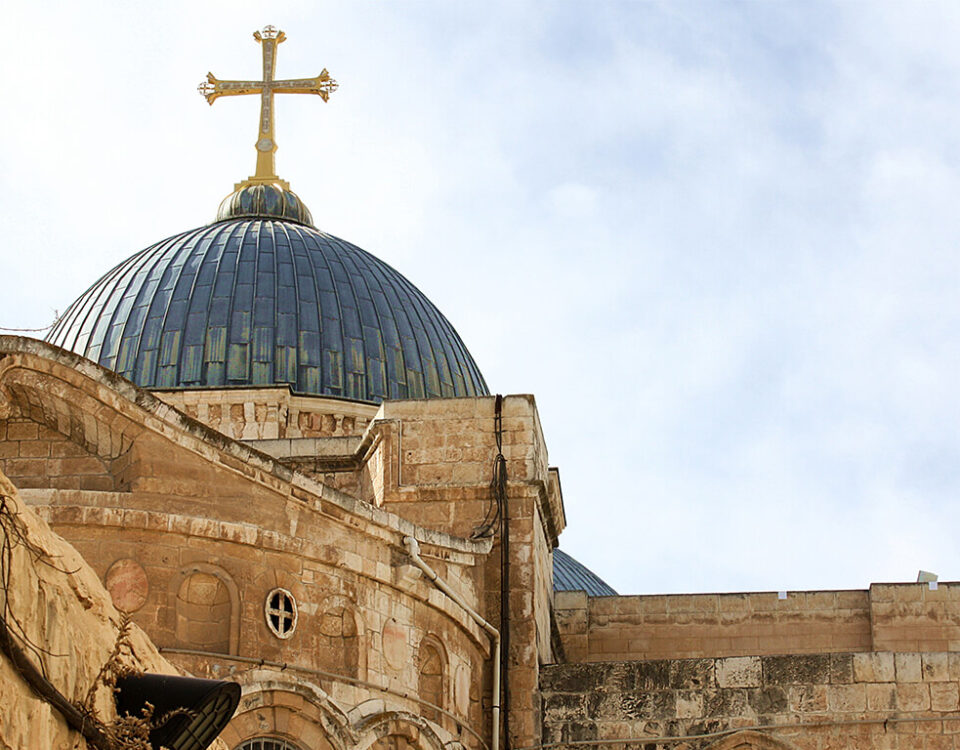
Perhaps the holiest pilgrimage site in Jerusalem is the Church of the Holy Sepulchre, also known as the Church of the Resurrection. Christians believe that it contains the tomb of Jesus Christ. Although opinions differ regarding its construction, the most widely accepted view is that it was built between 326 and 335 following Helena’s visit to Jerusalem.
Following the Council of Chalcedon (451), the church was divided among various Christian denominations. Over time, different groups occasionally gained dominance within the sanctuary. After the Crusades and the eventual Muslim reconquest of the region, the church and its possessions were allocated among several Christian communities, including Roman Catholics, Greek Orthodox, Armenians, Syriacs, Copts, and Ethiopians.
The belief in the holiness of the site and its relics, combined with the desire to possess more sacred space and objects, often generated rivalry among these communities and at times even led to open conflict.
## THE CRUSADES AND THE LATIN KINGDOM OF JERUSALEM
Jerusalem was conquered by the Muslims in 638. According to tradition, Patriarch Sophronius declared that he would surrender the city only to the Caliph himself. Consequently, Caliph Umar personally traveled to Jerusalem and, through the Covenant of Umar, guaranteed the religious freedom of the city’s Christian inhabitants.
For centuries thereafter, Christians living in Palestine continued their existence under Muslim rule as protected communities (*dhimmis*).
The advance of the Turks into Anatolia following the Battle of Manzikert alarmed Christian powers. In response, armies from Europe marched toward the Middle East. To recruit soldiers for what became known as the Crusades, religious sentiments were deliberately stirred. Christians were told that they were setting out to protect pilgrims and liberate Jerusalem from “infidel” Muslim control.
The Pope described the campaign as a holy war, and Christians were convinced that religion was the primary motivation behind the Crusades.
One papal appeal declared:
> “Jerusalem is the navel of the world. More fertile than all other lands, it is like a second paradise of delight. The Savior of mankind made it glorious by His birth, adorned it by His life, sanctified it by His suffering, redeemed it by His death, and sealed it by His burial. This noble city, situated at the center of the world, is now held captive by its enemies. It has been enslaved by a people who do not acknowledge God. Therefore, it longs for liberation and calls upon you without ceasing to come to its aid.”
The Crusaders captured Jerusalem on 15 July 1099 and established the Latin Kingdom of Jerusalem. Muslim inhabitants were massacred, while many Eastern Christians were expelled, apparently because of sectarian differences.
Jerusalem became the capital of the Latin Kingdom, and a church loyal to the Papacy was established there. Godfrey of Bouillon, the kingdom’s first ruler, refused the title of king out of humility, believing that Jesus Christ alone was the true King of Jerusalem. Instead, he adopted the title “Defender of the Holy Sepulchre.” His brother Baldwin I, who succeeded him in 1100, assumed the royal title.
On 2 October 1187, Salah al-Din (Saladin) recaptured Jerusalem from the Crusaders and restored Christian holy places to their traditional custodians. Although the Crusaders briefly regained the city in 1229, they were forced to relinquish it again in 1244.
Jerusalem would not return to Christian control until centuries later, when British forces occupied the city on 9 December 1917.
**Assoc. Prof. Dr. Eldar Hasanoğlu – Beyaz Tarih**
Hasanoğlu, Eldar. “Jerusalem in Christian Belief.” *Beyaz Tarih*. Published January 18, 2018. Accessed July 14, 2026. Originally published at Fikriyat.
Hasanoğlu, Eldar. “Hristiyan İnancında Kudüs.” *Fikriyat*, January 18, 2018.