Jerusalem Belongs to Us” Seminar Held in Siirt
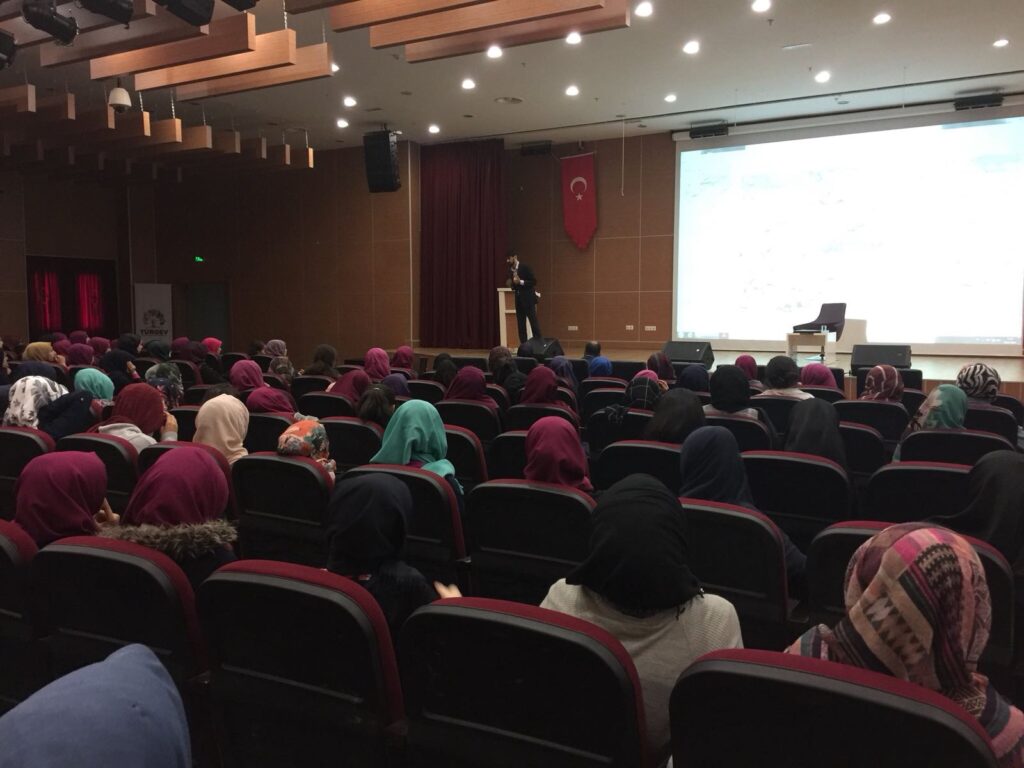
Here is the English translation of the text, formatted for clarity and readability:
## The Translation into English
When we look at the current state of the Palestine region, we see the period preceding its conquest by Caliph Omar. Today, the political maneuvers and plots played out over this city are far greater than in the past.
The importance of this city does not stem solely from its sacredness; looking at history, Jerusalem reflects the power and honor of the Muslim Ummah.
The conquest of Jerusalem during the era of Caliph Omar marks the beginning of a new era. While this conquest signaled the victory of the Ummah, it also served as a catalyst for Islam to spread rapidly like an avalanche.
Losing this city indicated that the Ummah was in danger and weakened. We see this clearly when looking at the historical periods of governance over the city. During the Ayyubid period (1187–1193), Jerusalem became the crown of the Ummah’s honor, dignity, and power. However, when the city was lost, weakness crept into the Ummah.
With the gradual weakening of Muslims and the dismantling of their unity, a historic opportunity arose for the Papacy, which was exhausted by the fragmentation of European countries and their wars with one another. Securing the support of Western society, the Papacy encouraged the public to unite once again, end their internal wars, and launch successive campaigns toward the Arab East. These wars, which they launched under the slogan "to rescue Christ's tomb from the filthy hands of pagans" (by which they meant Muslims) and named the "Crusades," were in reality a Western war based on worldly interests and pillaging, having absolutely nothing to do with religion as Muslims defined it.
This situation dealt a severe blow that deeply shook the Islamic conscience. Jerusalem was now under Crusader occupation. However, this occupation left a deep wound in the heart of the Islamic Ummah. From that day on, all Muslims believed that Jerusalem had to be liberated from Crusader occupation and spoke of this constantly. Jerusalem was now at the top of the Muslims' agenda. All the amirs, rulers, and the public at the head of the Islamic Ummah spoke of Jerusalem continuously, stating that this occupation must not last long. Yet, as a bitter reality of that time, fragmentation and internal conflicts had overrun the Islamic world. No one knew where to begin. The roads leading to Jerusalem had to be cleared.
The newly awakened Islamic consciousness, through the efforts of scholars, transformed into calls for reform, and it was not long before the fruits of these calls began to be harvested. Thus, a new generation of military and political leaders under the rule of the Zengids developed high strategies to expel the Crusaders and liberate Jerusalem. Ultimately, the victorious commander Saladin Ayyubi took over this banner, and God granted him the privilege of liberating Jerusalem.
Coming to the Ottoman period, the Ottoman Empire ruled Jerusalem for 400 years. During these periods, the Ottoman State was the greatest power in the world; even during its period of stagnation and decline, it drew strength from the city of Jerusalem under its sovereignty. The enemies of the Ottomans held them in respect and fear because they were well aware of the power the Ottomans held. For this reason, Sultan Abdulhamid Han did not give up on this city despite all pressures. Abdulhamid Han realized that the importance of this city did not consist merely of walls, houses, and mosques. He knew that if he lost this city, he would lose the entire empire.
The occupation of this sacred place—the blessed city of Jerusalem and its surrounding sanctuary, toward which the Prophet Muhammad ﷺ directed his prayers for 14 years out of his 23-year prophethood—is a source of humiliation and shame for the entire Ummah. Although the city was occupied from time to time in history by Crusaders or Jews, these occupations were short-lived, and Muslims always found a way to liberate this land.
---
### How Was Palestinian Land Occupied?
The strategy to occupy Palestine aligned with Western strategies first voiced in 1649. Indeed, a group of influential and wealthy Jews submitted a petition to the British government of the time, proposing the migration of the Children of Israel to the "Promised Land." Conditions ripened for the project to be launched, and a consensus on the project was reached at the Basel Congress in 1897, which brought together representatives of Zionist Jewish groups with the open support of international powers. Accordingly, the Zionist movement was considered part of the colonial strategy as well as European national projects. This project was adopted by Britain and France, who directed Western politics at the time, and they were highly generous regarding its financing.
The project in question covered significant ground during its implementation phase with the 1917 Balfour Declaration. Following the removal of the Ottomans from the region, under the supervision of the British occupation in Palestine, British Commander Allenby declared that the Crusades had now ended as he entered Jerusalem.
The objective of occupying Palestinian lands to settle Jews in the region was also expressed in the Sykes-Picot Agreement of 1916. In this agreement signed between Britain, France, and Russia, it was decided to settle Jews on these lands to establish a Jewish state. Since the purpose of this was to enable Jews to flock to those lands, with the start of the British occupation, Jews scattered across different parts of the world began to pour into Jerusalem and its surroundings like swarms of locusts. Due to this influx, the Jewish population in Jerusalem increased rapidly.
Sharif Hussein played a significant role in putting the Sykes-Picot agreement into practice and in the British occupation of Jerusalem. In exchange for the promised "Kingdom of the Arabian Peninsula," Sharif Hussein assisted the British in occupying Jerusalem and its surroundings. The clause regarding Palestine in the Sykes-Picot agreement stated: *"After obtaining the approval of the other partners and the Sharif of Mecca, an international administration shall be established in this region by discussing the matter with Russia,"* which clearly revealed the role of Hussein, who was the Sharif of Mecca at the time, in this betrayal.
Thus, the doors to Jewish immigration into Palestinian lands were opened under the complete patronage of Western and European powers. While the occupying British did not allow the Palestinian people to possess even a bread knife, the phenomenon of migration continued uninterrupted, and Zionist terrorist organizations were armed and trained. Disproportionate wars took place between scattered Arab armies and Zionist organizations that were superior in number and equipped with the latest technology weapons. Following these developments, the United Nations, within the framework of international laws, would prepare a legal ground for a foreign and dubious entity with undefined borders.
However, after World War II and the shift of power balances in the West in favor of America, the task of protecting the newly born Zionist entity was transferred to the United States. Indeed, in proportion to the increase in generous funding and support—such as money, weapons, media, and guardianship against any international backlash—the Jewish influence grew stronger. The alignment between the West and Zionism, converging around common strategic goals, began with efforts aimed at completely sidelining Islam, Muslims, and more specifically the Palestinian people. It continued its path with the goals of increasing divisions among Arabs and within the Islamic world to deprive the resistance power of all forms of support. This counter-mobilization launched in every field demonstrates that without the said American patronage, today's Zionist entity could never have materialized, nor could its continuation be possible.
The Zionist project began its international work by reaching out to all four corners of the world like an octopus. Indeed, this international dimension played a significant role in the birth phase of the Zionist project and subsequently provided it with all kinds of services to guarantee its permanence and supremacy. The tentacles of this octopus are spread across all continents and countries. As examples of these, we can count the Masonic movement and its sub-branches such as the Rotary, Lions, and Mediterranean clubs, as well as Jehovah's Witnesses.
On the other hand, giant media corporations and cultural and artistic branches like Hollywood support this project. Likewise, multinational companies and banks dedicate a portion of their revenues to the service of the Zionist ideology. In addition to these practices, generous donations made for plans to Judaize Jerusalem and confiscate the property of the indigenous population in various ways are also part of the equation. One of the methods used to seize the people's property is the extraordinarily high sums offered to Arab landowners.
The Zionists wanted to occupy West Jerusalem, annex it to East Jerusalem, and declare Jerusalem as the capital of Israel. Despite their grand plans aimed at expanding the occupation area to encompass one-third of the West Bank and expelling the Arab population from Jerusalem to Judaize it entirely, none of these actions have achieved legitimacy on the international stage. Yet, everyone has accepted the fait accompli; in fact, many Arab and Islamic countries have normalized their relations with the Zionist entity. In the meantime, no country has put forward the condition that the Zionist hand be lifted from East Jerusalem and Masjid al-Aksa—let alone the occupied West Bank and Gaza regions—and that it not become the eternal capital of Israel for the normalization of relations. On the very contrary, the Zionist lobby, active in decision-making mechanisms and particularly in the US Senate, makes sure to extract a pledge from everyone nominated for the US presidency that they will recognize Jerusalem as Israel's capital. Although no one has dared to fully realize this until now, if the silence and negligence of Arabs and Muslims continue like this, the probability of this happening remains.
---
### Echoes of the Resistance Movements
Despite all difficulties and hardships, conscious Muslims who were aware of the gravity of the situation and realized that their lands were being usurped began their struggle against this Zionist movement by confronting all the Western states that founded this entity.
As an important step in the Palestinian struggle, the First Islamic Congress convened in 1931 under the presidency of Haj Amin al-Husseini. In January 1933, massive protests condemning Britain were carried out all over Palestine. In 1935, another congress was organized with the participation of 500 prominent figures from Palestine. A resolution prohibiting the sale of land to Jews was passed at the congress. The extensive efforts made since 1921 were beginning to bear fruit.
Izz ad-Din al-Qassam, one of the symbolic figures of the Palestinian struggle, began working with all his might to raise a new generation. Al-Qassam was encouraging the youth he trained to wage jihad against the Zionists. He formed a group consisting of a total of two hundred people and distributed these youths across Palestine to fight against Jewish settlements. He was also the leader of the Haifa Muslim Young Men's Association and gave lessons at the Istiqlal Mosque. On November 20, 1935, Britain sent a military unit against him. Al-Qassam, along with some of his companions, was martyred.
When considering the achievements and efforts on the Palestinian stage, it is possible to see how much Imam Hassan al-Banna and his ideas influenced the Palestinian cause as another prominent figure. Al-Banna stated: *"Palestine is the homeland of every Muslim because it is a Muslim land, the cradle of Prophets, and contains the Masjid al-Aksa, whose surroundings Allah has blessed. The Palestinian cause is the cause of every Muslim."* Throughout this process, Ustadh Hassan al-Banna never broke his connection with Palestine; he sent his brother, Abd al-Rahman, to establish contact with Izz ad-Din al-Qassam. Al-Qassam had previously met Hassan al-Banna in Cairo.
Al-Qassam's martyrdom had a profound impact on awakening the consciousness of resistance in the hearts of the Palestinian people. Muslims carried the bodies of al-Qassam and his two companions for a distance of five kilometers. Funeral prayers in absentia were performed for him in most mosques in Palestine on November 22, 1935. Following this, al-Qassam became a symbol for jihad and an example of heroism and resistance. With the escalation of events in Palestine in 1936, the Muslim Brotherhood, under the leadership of Hassan al-Banna, organized aid campaigns and demonstrations for Palestine. A vanguard group of one thousand people from the Muslim Brotherhood was sent to support Palestine, while the group of ten thousand people he wished to send was blocked.
While Imam Hassan al-Banna paid the price for his love and sincerity toward Jerusalem, the Muslim Brotherhood organization he founded also paid the price for its jihad for Palestine. The Imam was martyred, the organization was banned, and its members were subjected to oppression, pressure, and torture. History will record Imam al-Banna as one of the rare figures in history who supported Palestine through thought, politics, press, propaganda, financial aid, and jihad.